

By Monika Manser
Introduction
The most frequent way of praying that Saint Ignatius uses is that of imagining ourselves in a Gospel scene. We imagine ourselves as a character in the story. We take part in the story, seeing Jesus and all the other people, being aware of what’s going on and how we are feeling. The purpose of praying with the imagination is to allow Christ in the Scripture to speak to us. To bring the Gospel stories to life for us. We are not trying to recreate history. It doesn’t matter if your imagination takes the story off in a different direction to the Scripture. It doesn’t matter if the story takes place in 1st century Palestine or where we live now in the 21st century. What is important is what God wants to say to us through this passage.
Let us sit and relax so that together we can contemplate the Gospel using our imagination.
Prayer
We acknowledge we are in the presence of God so let us say together:
Direct O Lord and guide and influence all that is happening in my mind and heart during this time of prayer: all my moods and feelings, my memories and imaginings; my hopes and desires; may all be directed and influenced to your greater glory, praise and service and to my growth in your Spirit.
Amen
Let the Spirit enter our hearts and enlighten our minds so that our promises will not be empty, our words not meaningless and that our actions will bear fruit.
Reading
Matthew 21:28-32
At that time: Jesus said to the chief priests and the elders of the people, ‘What do you think? A man had two sons. And he went to the first and said, “Son, go and work in the vineyard today.” And he answered, “I will not”, but afterwards he changed his mind and went. And he went to the other son and said the same. And he answered, “I go, sir”, but did not go.
Which of the two did the will of his father?’ They said, ‘The first.’ Jesus said to them, ‘Truly, I say to you, the tax collectors and the prostitutes go into the kingdom of God before you. For John came to you in the way of righteousness, and you did not believe him, but the tax collectors and the prostitutes believed him. And even when you saw it, you did not afterwards change your minds and believe him.’
Contemplation
Let us start our contemplation on the Gospel Reading of the 26th Sunday in Ordinary Time A by setting the scene. Prior to Jesus telling this parable, the religious leaders demanded to know Jesus’ authority for preaching and acting in the way he did. He had just expelled the traders from the temple and had laid claim to it calling it “My Father’s House”. The religious leaders were angry. So let us enter the scene as we listen to Jesus telling those religious leaders the kind of people will enter the Kingdom of Heaven..
- Who do you identify with in the scene? One of the disciples? One of the religious leaders? Someone who had come to pray in the temple? Someone hoping to be cured? Perhaps you identify with one of the sons or their father?
- Look around the stone courtyard of the Temple in Jerusalem. Notice the columns, the crowd as they gather around Jesus, and the defensive posture of the chief priests and elders standing opposite him.
- Listen to the sound of shifting feet, the distant echo of Temple commerce, and the resonance of Jesus’ voice as he breaks the tension with a question: “What is your opinion?”
- Feel the dry heat of the midday sun on your skin. Notice that the air of conflict. The religious leaders are trying to trap Jesus, but he pulls ground from beneath them with a simple story.
- What is going through your mind as you listen to this parable about the two brothers being asked to go into the vineyard?
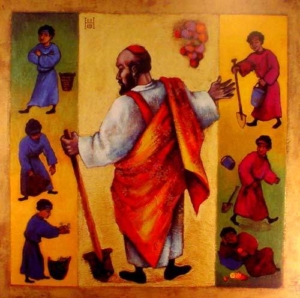
- Imagine you see the father and his two sons standing by the edge of the vineyard. Notice the father and how tired he looks. Watch him as he approaches his first son and hear him saying “Son, go and work today in the vineyard.”
- Notice his initial reaction as his son replies, “I will not.” Watch him as he walks away, rebellious and dismissive. Watch him later in the day a look of regret settling on his face. He changes his mind, turns around, and heads into the blazing heat of the vineyard to labour.
- Have you ever been in this situation? Been asked to do something and refused? Did you then feel guilty and then relent realising that you had been unreasonable and uncooperative? Did you realise that helping that person was more important than your own plans?
- Now watch the father as he goes to the second son with the same request. This son smiles politely, and says exactly what the father wants to hear: “I will go, sir.” Watch him after his father leaves. He sits down. He shrugs. He never steps foot in the vineyard. His obedience was only in his words.
- Have you ever been in the situation of the second brother? Been asked to do something, said you would do it and then not do it? Did you want to sound co-operative even though you had no intentions of doing so?
- Has someone ever promised you something and then let you down? Has someone ever refused you and then changed their minds? What Jesus is asking us is if our words and deeds are in agreement with each other.
- What is going through your mind as you continue listening to Jesus? Which son resonates with your life right now? Do you find yourself saying “yes” to God in public or in prayer, but withholding your actual energy and actions? Or are you wrestling with a “no” right now, needing the grace to change your mind and go into the vineyard?
- Feel the wave of shock go through the crowd as Jesus delivers his striking conclusion: “Tax collectors and prostitutes are entering the kingdom of God before you.” Look at the expressions on the faces of the chief priests—their indignation, their wounded pride. Look around the crowd and notice the outcasts, the marginalised, and the broken people who are relieved because they felt they too had a chance to enter the Kingdom of God.
Let us now spend 10 minutes in the company of Jesus and tell him about the areas where you are slow to move, where you are hiding behind good intentions, or where you need the courage to change direction. Listen quietly for whatever he wants to say to you in return.
Sharing
Let us now share what we thought, felt etc. only if you are comfortable to do so.
End Prayer
Suscipe of St. Ignatius of Loyola
Take, Lord, and receive all my liberty,
my memory, my understanding,
and my entire will,
All I have and call my own.
You have given all to me.
To you, Lord, I return it.
Everything is yours; do with it what you will.
Give me only your love and your grace,
that is enough for me.
Scripture texts: from the Jerusalem Bible 1966 by Dartington Longman & Todd Ltd and Doubleday and Company Ltd