

By Monika Manser
Introduction
The most frequent way of praying that Saint Ignatius uses is that of imagining ourselves in a Gospel scene. We imagine ourselves as a character in the story. We take part in the story, seeing Jesus and all the other people, being aware of what’s going on and how we are feeling. The purpose of praying with the imagination is to allow Christ in the Scripture to speak to us. To bring the Gospel stories to life for us. We are not trying to recreate history. It doesn’t matter if your imagination takes the story off in a different direction to the Scripture. It doesn’t matter if the story takes place in 1st century Palestine or where we live now in the 21st century. What is important is what God wants to say to us through this passage.
Let us sit and relax so that together we can contemplate the Gospel using our imagination.
Prayer
We acknowledge we are in the presence of God so let us say together:
Direct O Lord and guide and influence all that is happening in my mind and heart during this time of prayer: all my moods and feelings, my memories and imaginings; my hopes and desires; may all be directed and influenced to your greater glory, praise and service and to my growth in your Spirit.
Amen
Let the Spirit enter our hearts and enlighten our minds to our responsibility of being good tenants in God’s vineyard and producing fruit that will last.
Reading
Matthew 21:33-43
At that time: Jesus said to the chief priests and the elders of the people, ‘Hear another parable. There was a master of a house who planted a vineyard and put a fence round it and dug a wine press in it and built a tower and leased it to tenants, and went into another country. When the season for fruit drew near, he sent his servants to the tenants to get his fruit. And the tenants took his servants and beat one, killed another, and stoned another. Again he sent other servants, more than at first. And they did the same to them. Finally he sent his son to them, saying, “They will respect my son.” But when the tenants saw the son, they said to themselves, “This is the heir. Come, let us kill him and have his inheritance.” And they took him and threw him out of the vineyard and killed him. When therefore the owner of the vineyard comes, what will he do to those tenants?’ They said to him, ‘He will put those wretches to a miserable death and let out the vineyard to other tenants who will give him the fruits in their seasons.’
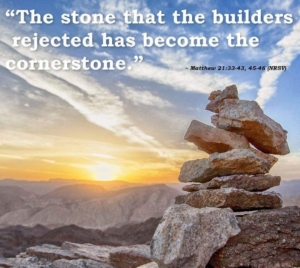
Jesus said to them, ‘Have you never read in the Scriptures: “The stone that the builders rejected has become the cornerstone; this was the Lord’s doing, and it is marvellous in our eyes”? Therefore I tell you, the kingdom of God will be taken away from you and given to a people producing its fruits.’
Contemplation
The reading of the 27th Sunday in Ordinary Time, Year A is a continuation of last Sunday’s Gospel about the parable of the two sons sent by their father to work in his vineyard. So let us enter the scene and listen to Jesus continuing to talk to the disbelieving religious leaders and see what connections you make regarding the characters of the story..
- Who are you in the scene? One of the disciples? One of the religious leaders? Someone coming to hear Jesus? Perhaps someone in the parable i.e. one of the tenants. one of the servants or the landowner? Someone who is not mentioned in the passage?
- Where is Jesus talking to you? In the open air? In the Temple? In a private room?
- Look at the crowd gathered around Jesus. Notice a group of chief priests and elders with their rich robes looking at Jesus suspiciously. Find a spot, close enough to hear every word. Are there many people listening? What is the atmosphere like? Is it noisy? Hostile? Attentive? What is Jesus’ mood like?
- As Jesus speaks, let the scene build in your mind:
- Imagine a beautiful vineyard carved into the hillside. The soil is rich, and the vines are heavy with ripe grapes. In the centre, notice the watchtower standing tall against the blue sky.
- Watch the owner as he walks through the gates, turning back one last time to look at his vineyard before he embarks on a long journey, leaving the vineyard in the hands of his trusted tenants.
- Now imagine yourself in the vineyard. The harvest season arrives and the landowner sends his servants. Watch the tenants as greed takes over. Watch them seize the first servant, beat him, stone another, and kill a third. Then watch as the same fate is exacted on the second lot of servants. Feel the shock of the crowd around you as Jesus describes this violence.
- Finally he sent his son to them, saying, ‘They will respect my son.’” Look at the son as he approaches the vineyard. He looks vulnerable, carrying only his father’s authority. Listen to the tenants saying: “This is the heir; come, let us kill him and get his inheritance.” They drag him out of the vineyard and kill him.
- How does this make you feel? In what areas of your life – your talents, time, or love – do you act like an owner rather than a tenant? Where are you holding back the fruit that belongs to God?
- Watch Jesus as he as he asks the chief priests, “When therefore the owner of the vineyard comes, what will he do to those tenants?’ listen to their voices as they reply, ‘He will put those wretches to a miserable death and let out the vineyard to other tenants who will give him the fruits in their seasons.’
- Jesus said to them, ‘Have you never read in the Scriptures: “The stone that the builders rejected has become the cornerstone; this was the Lord’s doing, and it is marvellous in our eyes”? He will put those wretches to a miserable death and let out the vineyard to other tenants who will give him the fruits in their seasons.’
- Look at the chief priests. Watch their faces flush with sudden realisation and anger as they grasp that the parable is a direct judgment against them.
- How do you see your labours? A challenge? A joy? What do you do with the fruits of your labours? As a tenant, do you protect the vineyard and treasure its fruits and share them with those in need? Or do you store the fruits for yourself thinking that you worked for them so you think they are yours and not God’s?
- How do you treat those servants who come to remind you of your responsibility to your tenancy? Do you listen, take note but do nothing? Can you think of anyone in particular who are prophets? Is there anyone in particular who inspires you to be a better tenant?
- As you listen to Jesus, do you realise that he is that Son, the one who will be put to death? Or are you listening to the parable in a literal sense and feel sorry for the landowner who thinks they will respect his son?
- Do you see Jesus as being the cornerstone in this parable, the one who has been rejected and who has now become the keystone?
Let us now spend 10 minutes in the company of Jesus. Listen to what he says to you. Offer him your desires to be a faithful caretaker. Talk to him about the vineyard of the kingdom being entrusted to you and the part you might play in enabling it to flourish?
Sharing
Let us now share what we thought, felt etc. only if you are comfortable to do so.
End Prayer
Suscipe of St. Ignatius of Loyola
Take, Lord, and receive all my liberty,
my memory, my understanding,
and my entire will,
All I have and call my own.
You have given all to me.
To you, Lord, I return it.
Everything is yours; do with it what you will.
Give me only your love and your grace,
that is enough for me.
Scripture texts: from the Jerusalem Bible 1966 by Dartington Longman & Todd Ltd and Doubleday and Company Ltd