

By Monika Manser
Introduction
The most frequent way of praying that Saint Ignatius uses is that of imagining ourselves in a Gospel scene. We imagine ourselves as a character in the story. We take part in the story, seeing Jesus and all the other people, being aware of what’s going on and how we are feeling. The purpose of praying with the imagination is to allow Christ in the Scripture to speak to us. To bring the Gospel stories to life for us. We are not trying to recreate history. It doesn’t matter if your imagination takes the story off in a different direction to the Scripture. It doesn’t matter if the story takes place in 1st century Palestine or where we live now in the 21st century. What is important is what God wants to say to us through this passage.
Let us sit and relax so that together we can contemplate the Gospel using our imagination.
Prayer
We acknowledge we are in the presence of God so let us say together:
Direct O Lord and guide and influence all that is happening in my mind and heart during this time of prayer: all my moods and feelings, my memories and imaginings; my hopes and desires; may all be directed and influenced to your greater glory, praise and service and to my growth in your Spirit.
Amen
Let the Spirit enter our hearts and minds so that we can ask for the grace to not be caught unawares and to be prepared at all times.
Reading
Matthew 25:1-13
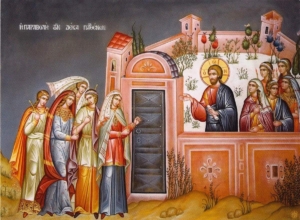
At that time: Jesus told his disciples this parable, ‘The kingdom of heaven will be like ten virgins who took their lamps and went to meet the bridegroom. Five of them were foolish, and five were wise. For when the foolish took their lamps, they took no oil with them, but the wise took flasks of oil with their lamps.
As the bridegroom was delayed, they all became drowsy and slept. But at midnight there was a cry, “Here is the bridegroom! Come out to meet him.” Then all those virgins rose and trimmed their lamps. And the foolish said to the wise, “Give us some of your oil, for our lamps are going out.” But the wise answered, saying, “Since there will not be enough for us and for you, go rather to the dealers and buy for yourselves.”
And while they were going to buy, the bridegroom came, and those who were ready went in with him to the marriage feast, and the door was shut. Afterwards the other virgins came also, saying, “Lord, lord, open to us.” But he answered, “Truly, I say to you, I do not know you.” Watch therefore, for you know neither the day nor the hour.’
Contemplation
As we approach the end of this Liturgical Year, here on the 32nd Sunday in Ordinary Time, Jesus talks about the end-times by comparing the Kingdom of heaven to a scene that people at that time are familiar with – a Jewish wedding. But this time we are being warned to be prepared and warned of the consequences if we are not. So let us enter the scene and listen to Jesus tell us what will happen if we do are not prepared.
-
Who are you in the scene? One of the disciples? One of the crowd? Perhaps a Scribe or a Pharisee? A follower of Jesus? Perhaps you are one of the bridesmaids or the groom or a bystander in the parable watching the story unfold or someone who is not mentioned in the passage?
- Where is Jesus talking? In the temple? In an open space? In the market place?
- Where are you in the crowd? In the front? Middle? On the margins?
- Look at the expressions of those around you. Are they listening with intent, curiosity, interest?
- As Jesus starts the parable, imagine you are in a small, ancient village. It is late at night, the air is cool, and the world around the village is silent except for the crickets and nocturnal animals.
- You notice ten young bridesmaids leaning against a wall. Some are dozing, heads dropped to their chests; others are restless, adjusting the wicks of their lamps. Look at their faces. Some seem anxious, checking their small clay lamps over and over. Others look calm, chatting softly, with extra stone jars of oil nestled safely by their side.
- Which group do you associate with in this scene? One of the foolish bridesmaids who have not brought extra oil, watching the flame sputter and feeling a cold spike of panic as the oil level drops? One of the wise bridesmaids, quietly confident with your small flask of extra oil tucked safely by your side?
- Feel the weight of the hours ticking past. Notice how initial excitement turns into heavy eyelids. Everyone grows drowsy and falls asleep, both the wise and the foolish alike.
- What does waiting feel like in your own spiritual life? Are you willing to wait for God (the bridegroom) even when you do not know the specific time he will come? Do you like to be prepared for all eventualities?
- Are you excited when you are awoken by the cry that the bridegroom is here? Watch the panic of the five who realise their lamps are dying. Hear the reply of the wise: “Since there will not be enough for us and for you, go rather to the dealers and buy for yourselves.” Does this sound harsh to you? Do you realise that spiritually, you cannot borrow someone else’s inner relationship with God.
- Watch the five unprepared women run frantically into the dark streets, desperate to find an oil dealer who is awake at midnight. Do you feel sorry for them because they had not looked beyond the present moment and had relied on the bare minimum? Does your relationship with God consist of doing the bare minimum? Are you generous in your relationships both with God and others?
- Watch the wise bridesmaids light up their bright torches, joining the joyful procession into the banquet hall. Listen to the thud of the wooden door as it shuts behind them. Feel the panic of those who had to run off too late to find more oil.
- How does it make you feel when these five women return, knocking frantically on the door shouting “Lord, lord, open to us!”and the Bridegroom’s voice behind the door says “Truly I say to you, I do not know you?” How does it make you feel that the five women are left outside in the cold, dark street?
Let us now spend ten minutes in the company of Jesus. Ask him what is the ‘oil’ in you life that is running low. Is it faith, prayer, love, or forgiveness? Talk to him about where you notice complacency or the temptation to assume there is always more time? Talk to him about your readiness to find God in your daily life.
Sharing
Let us now share what we thought, felt etc. only if you are comfortable to do so.
End Prayer
Suscipe of St. Ignatius of Loyola
Take, Lord, and receive all my liberty,
my memory, my understanding,
and my entire will,
All I have and call my own.
You have given all to me.
To you, Lord, I return it.
Everything is yours; do with it what you will.
Give me only your love and your grace,
that is enough for me.
Scripture texts: from the Jerusalem Bible 1966 by Dartington Longman & Todd Ltd and Doubleday and Company Ltd