

By Monika Manser
Introduction
The most frequent way of praying that Saint Ignatius uses is that of imagining ourselves in a Gospel scene. We imagine ourselves as a character in the story. We take part in the story, seeing Jesus and all the other people, being aware of what’s going on and how we are feeling. The purpose of praying with the imagination is to allow Christ in the Scripture to speak to us. To bring the Gospel stories to life for us. We are not trying to recreate history. It doesn’t matter if your imagination takes the story off in a different direction to the Scripture. It doesn’t matter if the story takes place in 1st century Palestine or where we live now in the 21st century. What is important is what God wants to say to us through this passage.
Let us sit and relax so that together we can contemplate the Gospel using our imagination.
Prayer
We acknowledge we are in the presence of God so let us say together:
Direct O Lord and guide and influence all that is happening in my mind and heart during this time of prayer: all my moods and feelings, my memories and imaginings; my hopes and desires; may all be directed and influenced to your greater glory, praise and service and to my growth in your Spirit.
Amen
Let the Spirit enter our hearts and enlighten our minds as we listen to and reflect on the parable of the sower. Let the Spirit enrich our hearts and minds so that the seed of God’s word can be sown within us, take root and bear fruit.
Reading
Matthew 13:1-9
At that time: Jesus went out of the house and sat beside the lake. And great crowds gathered about him, so that he got into a boat and sat down. And the whole crowd stood on the beach.
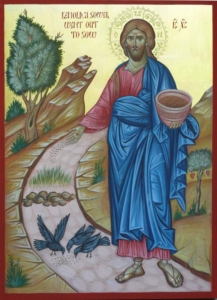
And he told them many things in parables, saying: ‘A sower went out to sow. And as he sowed, some seeds fell along the path, and the birds came and devoured them. Other seeds fell on rocky ground, where they did not have much soil, and immediately they sprang up, since they had no depth of soil, but when the sun rose they were scorched. And since they had no root, they withered away. Other seeds fell among thorns, and the thorns grew up and choked them. Other seeds fell on good soil and produced grain, some a hundredfold, some sixty, some thirty. He who has ears, let him hear.’
Contemplation
In this Gospel passage from St Matthew, on the 15th Sunday in Ordinary time, Jesus tells his listeners how the Word of God is received by using every day analogies to capture the minds of his listeners..He compares his Spiritual Message to seeds being scattered by a sower. So close your eyes and imagine the scene, find a place within it. With the help of the Spirit, let the Word of God be implanted in your imagination.
-
Who are you in the scene? One of the disciples? One of the crowds? A passer-by who has stopped to listen? The sower? The seeds? The soil? The pouch carrying the precious seeds? Something that is not mentioned in the passage?
- Notice the terrain, the dust created by the crowd. Notice the gentle, lapping water of the Sea of Galilee. Are the surroundings similar to those that Jesus describes in his parable?
- Listen to the murmur of the eager crowd, the gentle creak of the wooden fishing boat, the cry of a passing bird.
- Picture yourself on the shore. Feel the warm Mediterranean sun on your skin, the cool breeze coming off the water, and the texture of the sand beneath your feet.
- Notice what is going on around you. Look at the faces of those who are listening. What do you see in them? Attentiveness? Anticipation? Hope?
- How close are you to Jesus? Are you sitting near the front or the back of the crowd?
- Look at Jesus’ face as He speaks. Notice His expressions—the warmth in His eyes. Is he looking at you?
- As you listen to Jesus do you wonder why he uses parables to teach? Do these parables help you understand the message he is trying to convey about the Kingdom of Heaven? Do his analogies to every day life strike a chord with you?
- Visualize the sower scattering seed across the landscape. Watch what happens to the seed as it lands on the different terrains:
The Path: Imagine a hard-packed well travelled dirt path. watch as the birds swoop down suddenly to snatch the seed away before it has a chance. Do you sometimes feel hard-packed and rushed like the path?
The Rocky Ground: Imagine patches of shallow dirt sitting over limestone. Watch the seeds sprout up quickly in the sun, only to wither just as fast when they can’t put down deep roots. Are there time when you are enthusiastic but shallow like the rocky ground? Are there areas in your life that God’s word does not have a chance to mature and grow because the rocks and barriers prevent them?
The Thorns: Imagine overgrown patches of thistles and weeds. Watch the bright green shoots try to rise, only to be choked and suffocated by the dense, aggressive thorns. What are the thorns that choke your faith and hope? Is your attention divided and choked out by worldly anxieties like the thorns?
The Rich Soil: Imagine the deep, dark, nourishing earth. See the seeds land softly, take deep roots, and grow into strong, healthy plants that yield an abundant harvest. Are you grounded and fruitful like the rich soil? How do you nurture your faith and that of others? Where do you see the richness that produces a good harvest in your life and in those around you?
- In the daily events of your own life, how do you attend to the seeds of God in your decisions? Are you open to receiving these seeds, the word of God? How have you prepared yourself to receive the seeds? What nourishment do you need to help these seeds to grow? Do you need help to uproot the weeds and remove the stones so that your seeds can flourish?
Is there anything you would like to say to Jesus about this parable? Speak to him about what you have observed. Tell Him how the scene made you feel and ask Him for the grace to transform any rocky or thorny areas of your life into rich soil. Listen to what He might be speaking to your heart in return.
Sharing
Let us now share what we thought, felt etc. only if you are comfortable to do so.
End Prayer
Suscipe of St. Ignatius of Loyola
Take, Lord, and receive all my liberty,
my memory, my understanding,
and my entire will,
All I have and call my own.
You have given all to me.
To you, Lord, I return it.
Everything is yours; do with it what you will.
Give me only your love and your grace,
that is enough for me.
Scripture texts: from the Jerusalem Bible 1966 by Dartington Longman & Todd Ltd and Doubleday and Company Ltd