

By Monika Manser
Introduction
The most frequent way of praying that Saint Ignatius uses is that of imagining ourselves in a Gospel scene. We imagine ourselves as a character in the story. We take part in the story, seeing Jesus and all the other people, being aware of what’s going on and how we are feeling. The purpose of praying with the imagination is to allow Christ in the Scripture to speak to us. To bring the Gospel stories to life for us. We are not trying to recreate history. It doesn’t matter if your imagination takes the story off in a different direction to the Scripture. It doesn’t matter if the story takes place in 1st century Palestine or where we live now in the 21st century. What is important is what God wants to say to us through this passage.
Let us sit and relax so that together we can contemplate the Gospel using our imagination.
Prayer
We acknowledge we are in the presence of God so let us say together:
Direct O Lord and guide and influence all that is happening in my mind and heart during this time of prayer: all my moods and feelings, my memories and imaginings; my hopes and desires; may all be directed and influenced to your greater glory, praise and service and to my growth in your Spirit.
Amen
Let the Spirit enter our hearts and enlighten our minds so that we can respond to the generosity of God who calls us all to work in his vineyard.
Reading
Matthew 20:1-16
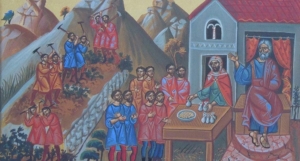
Jesus said to his disciples: “The kingdom of heaven is like a landowner going out at daybreak to hire workers for his vineyard. He made an agreement with the workers for one denarius a day, and sent them to his vineyard. Going out at about the third hour he saw others standing idle in the market place and said to them, ‘You go to my vineyard too and I will give you a fair wage.’ So they went. At about the sixth hour and again at about the ninth hour, he went out and did the same. Then at about the eleventh hour he went out and found more men standing round, and he said to them, ‘Why have you been standing here idle all day?’ ‘Because no one has hired us,’ they answered. He said to them, ‘You go into my vineyard too.’ In the evening, the owner of the vineyard said to his bailiff, ‘Call the workers and pay them their wages, starting with the last arrivals and ending with the first.’
So those who were hired at about the eleventh hour came forward and received one denarius each. When the first came, they expected to get more, but they too received one denarius each. They took it, but grumbled at the land-owner. ‘The men who came last’ they said, ‘have done only one hour, and you have treated them the same as us, though we have done a heavy day’s work in all the heat.’ He answered one of them and said, ‘My friend, I am not being unjust to you; did we not agree on one denarius? Take your earnings and go. I choose to pay the last comer as much as I pay you. Have I no right to do what I like with my own? Why be envious because I am generous?’ Thus the last will be first, and the first, last.”
Contemplation
This is the 25th Sunday in Ordinary Time A and in this reading, Jesus explains to his disciples that God’s ways are not our ways since we think using human standards. So let us enter the scene as we listen to Jesus telling us what God’s justice and righteousness is like compared with ours.
- Who are you in the scene? One of the disciples? A passer-by? Someone eavesdropping into the conversation between Jesus and his disciples? Someone who is not mentioned in the passage?
- Where is this conversation taking place? In the open air? If so are there many people around? Or are you sitting indoors around a table, just you disciples and Jesus, perhaps eating a meal?
- Notice what is going on around you. Notice the expressions on the faces of those listening. What about the expression on Jesus’ face as he talks to you? What is the general mood like?
- Who do you relate to in this parable as Jesus tells you about what the Kingdom of heaven is like? Those disgruntles workers who have toiled all day? The grateful latecomers? The generous landowner?
- Put yourself in the parable and picture the town square at daybreak. Imagine the cool early morning air as the sun begins to rise. Listen to the murmur of the crowd and notice men talking anxiously about needing work to feed their families.
- Watch as the landowner approaches. He looks at you. What does his voice sound like when he says, “You too go into my vineyard”?
- If you were picked early, feel the physical toll of the day. The blazing midday sun, the heavy baskets of grapes, the sweat pouring down your face.
- If you were picked at the 11th hour, feel the profound relief of finally being chosen just as the day is almost over.
- If you were an early worker, how do you feel when evening comes and the late arrivals get paid the same as you? Do you feel resentful?
- If you are the late hour worker imagine the shock and immense relief and gratitude when you receive a full day’s pay for just one hour of work.
- If you are a bystander, watch the pay being distributes at sunset, and hear the sharp complaints against the generous master of those who were first-hired.
- Watch the landowner as he addresses the complaints. He looks right at you. He asks, “Am I not allowed to do what I choose with what belongs to me? Or are you envious because I am generous?” How do those words resonate with you?
- Does the landowner’s words and actions challenge you? Do you think that he should have paid all the workers the same wage? In your mind should those who did less work have received less money than those who had been working all day? Would you have complained if you had been working all day through the midday sun and received the same wage as those who arrived late?
- Do you think the needs of the latecomers were any different from the needs of those who started work early? That Jesus is trying to tell us that God’s love, generosity and justice is distributed to us abundantly and equally and not according to any equation? Do you have preconceived notions as to how justice and fairness should be distributed?
- Listen to Jesus as he tries to explain to us that God’s interpretation of justice and fairness is different to ours.
Let us now spend 10 minutes in the company of Jesus. Talk to him about your own struggles with comparison, envy, or feeling like you have to earn your worth. Tell Jesus about the times you’ve felt unrecognised, or when life felt deeply unfair. Also tell him of the times you have been grateful for the small mercies you have received. Listen to what Jesus wants to say back to you.
Sharing
Let us now share what we thought, felt etc. only if you are comfortable to do so.
End Prayer
Suscipe of St. Ignatius of Loyola
Take, Lord, and receive all my liberty,
my memory, my understanding,
and my entire will,
All I have and call my own.
You have given all to me.
To you, Lord, I return it.
Everything is yours; do with it what you will.
Give me only your love and your grace,
that is enough for me.
Scripture texts: from the Jerusalem Bible 1966 by Dartington Longman & Todd Ltd and Doubleday and Company Ltd