

By Monika Manser
Introduction
The most frequent way of praying that Saint Ignatius uses is that of imagining ourselves in a Gospel scene. We imagine ourselves as a character in the story. We take part in the story, seeing Jesus and all the other people, being aware of what’s going on and how we are feeling. The purpose of praying with the imagination is to allow Christ in the Scripture to speak to us. To bring the Gospel stories to life for us. We are not trying to recreate history. It doesn’t matter if your imagination takes the story off in a different direction to the Scripture. It doesn’t matter if the story takes place in 1st century Palestine or where we live now in the 21st century. What is important is what God wants to say to us through this passage.
Let us sit and relax so that together we can contemplate the Gospel using our imagination.
Prayer
We acknowledge we are in the presence of God so let us say together:
Direct O Lord and guide and influence all that is happening in my mind and heart during this time of prayer: all my moods and feelings, my memories and imaginings; my hopes and desires; may all be directed and influenced to your greater glory, praise and service and to my growth in your Spirit.
Amen
As you listen to Jesus with his disciples, let the Spirit enter your heart so that when Jesus asks you the question “Who do you say I am?” you can answer with the same conviction as Peter “You are the Christ, the Son of the Living God”.
Reading
Matthew 16:13-19
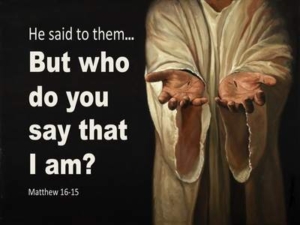
At that time: When Jesus came into the district of Caesarea Philippi, he asked his disciples, ‘Who do people say that the Son of Man is?’ And they said, ‘Some say John the Baptist, others say Elijah, and others Jeremiah or one of the prophets.’ He said to them, ‘But who do you say that I am?’
Simon Peter replied, ‘You are the Christ, the Son of the living God.’ And Jesus answered him, ‘Blessed are you, Simon Bar-Jonah! For flesh and blood has not revealed this to you, but my Father who is in heaven. And I tell you, you are Peter, and on this rock I will build my Church, and the gates of hell shall not prevail against it. I will give you the keys of the kingdom of heaven, and whatever you bind on earth shall be bound in heaven, and whatever you loose on earth shall be loosed in heaven.’
Contemplation
Let us start our contemplation by setting the scene. This passage comes from Matthew Chapter 16. Jesus has journeyed with his disciples to Caesarea Philippi, a pagan place of worship and the source of the River Jordan. With this in mind, and with the help of the Spirit, imagine you are travelling with Jesus to Caesarea Philippi, find a place within this passage and amidst the beauty of the location and contemplate “Who is Jesus to you?”
-
Who are you within the story? Are you one of the Twelve? Perhaps an onlooker? Or someone else who is not mentioned in the passage or even an inanimate object.
- As you are journeying with Jesus, feel the warm, dusty gravel under your feet. Look up at the lush, green slopes of Mount Hermon and the craggy cliffs. Notice the clear rushing waters of the Jordan River.
- What sounds do you hear? Perhaps the chatter of the disciples, or the breeze through the trees, or the birds in the air or the rushing of the waterfalls on the Jordan.
- As you stop to rest, are you wondering why Jesus took you to this place? A place of beauty but a place of known pagan worship?
- Where does Jesus settle down to talk to you? In the cave of Pan? In the temple dedicated to Caesar? At the source of the Jordan? Or are you sitting on one of the rocks?
- Watch Jesus as looks at the group, his eyes warm but deeply searching. He asks softly, “Who do people say that the Son of Man is?” Listen to the answers some in the group give. “Elijah”, “John the Baptist” “one of the prophets”? Do you sit quietly listening to everyone else?
- Notice how Jesus looks directly at you when He asks the question. “But you, who do you say I am?” What rises up in your mind? Is there hesitation, certainty, or a question you want to ask Him in return? Do you feel uncomfortable?
- Watch Simon Peter come forward and answer with conviction, “You are the Christ, the Son of the living God.” Do you believe and affirm with love Simon Peter’s declaration of faith in Jesus, not just as Messiah, but as the Son of God? Or is Jesus someone different for you? Imagine yourself stepping forward and answering Him in your own words, just as Simon Peter did.
- What is Jesus’ reaction at Simon Peter’s declaration of faith? Does he look pleased? Relieved because Simon Peter is now thinking on a spiritual plane and not in an earthly way?
- When Jesus said that it was his Father in heaven who had revealed to Simon Peter this outpouring of faith, how did it make you feel?
- Watch Jesus as he renames Simon and said that he would build his Church on him. Hear the authority, and love in Jesus’ voice as He says: “You are Peter, and on this rock I will build my church, and the gates of hell shall not prevail against it.” Ponder what it would be like for you to embody the qualities of a rock- always securely grounded in Christ. How does this feel?
- Watch as Jesus entrusts the “keys of the kingdom” into Peter’s hands.
- Is there anything you want to say to Peter? Is there anything you want to say to Jesus?
Imagine sitting next to Jesus on the rock. Tell Him what you genuinely think of Him today. Ask Him what it means for Him to be the “rock” in your life right now.
Let us now spend 10 minutes in the company of Jesus
Sharing
Let us now share what we thought, felt etc. only if you are comfortable to do so.
End Prayer
Suscipe of St. Ignatius of Loyola
Take, Lord, and receive all my liberty,
my memory, my understanding,
and my entire will,
All I have and call my own.
You have given all to me.
To you, Lord, I return it.
Everything is yours; do with it what you will.
Give me only your love and your grace,
that is enough for me.
Scripture texts: from the Jerusalem Bible 1966 by Dartington Longman & Todd Ltd and Doubleday and Company Ltd