

By Monika Manser
Introduction
The most frequent way of praying that Saint Ignatius uses is that of imagining ourselves in a Gospel scene. We imagine ourselves as a character in the story. We take part in the story, seeing Jesus and all the other people, being aware of what’s going on and how we are feeling. The purpose of praying with the imagination is to allow Christ in the Scripture to speak to us. To bring the Gospel stories to life for us. We are not trying to recreate history. It doesn’t matter if your imagination takes the story off in a different direction to the Scripture. It doesn’t matter if the story takes place in 1st century Palestine or where we live now in the 21st century. What is important is what God wants to say to us through this passage.
Let us sit and relax so that together we can contemplate the Gospel using our imagination.
Prayer
We acknowledge we are in the presence of God so let us say together:
Direct O Lord and guide and influence all that is happening in my mind and heart during this time of prayer: all my moods and feelings, my memories and imaginings; my hopes and desires; may all be directed and influenced to your greater glory, praise and service and to my growth in your Spirit.
Amen
Let the Spirit enter our hearts and enlighten our minds to awareness of our responsibility to both the spiritual and the temporal dominion.
Reading
Matthew 22:15-21
At that time: The Pharisees went and plotted how to entangle Jesus in his words. And they sent their disciples to him, along with the Herodians, saying, ‘Teacher, we know that you are true and teach the way of God truthfully, and you do not care about anyone’s opinion, for you are not swayed by appearances. Tell us, then, what you think. Is it lawful to pay taxes to Caesar, or not?’
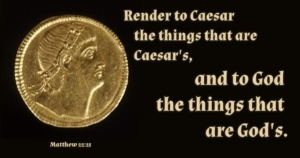
But Jesus, aware of their malice, said, ‘Why put me to the test, you hypocrites? Show me the coin for the tax.’ And they brought him a denarius. And Jesus said to them, ‘Whose likeness and inscription is this?’ They said, ‘Caesar’s.’ Then he said to them, ‘Therefore render to Caesar the things that are Caesar’s, and to God the things that are God’s.’
Contemplation
In the past few Sunday Gospel Readings, Jesus has been addressing the religious leaders berating them for their leadership. In today’s reading on the 29th Sunday in Ordinary Time, Jesus is being challenged by the Pharisees and the Herodians, their plan being to attempt to get Jesus to discredit himself and thus catch him out. With this in mind, let us enter the scene and listen to Jesus’ reply to a seemingly innocent question.
-
Who are you in the scene? One of the disciples? One of the disciples of the Pharisees? One of the Herodians? Someone following Jesus? Or are you a bystander, curious to see if this controversial rabbi will finally slip up?
- As you stand, look around at the limestone walls reflecting the bright Judean sun. Look at the crowds of Passover pilgrims gathering in clusters. Notice the contrast in clothing between the robes of the Pharisees and attire of the Herodians. Are you surprised to see that they have formed an unlikely alliance against Jesus? Do you immediately think there is going to be trouble since you know that Pharisees and Herodians despise each other?
- Listen to the ambient noise: the distant bleating of sacrificial animals, the clinking of coins at the money-changers’ tables, and the low hum of people talking.
- Feel the dry, hot wind against your skin and smell the different odours of meat and herbs of the market place.
- Where does this discussion take place? In the Temple? In the market place? In public? Where are you standing?
-
What is going through your mind when you see the Pharisees and Herodians together approaching Jesus?
-
Listen closely as their spokesperson steps forward and says, ‘Teacher, we know that you are true and teach the way of God truthfully’. Look the faces of those who are seeking to trap Jesus? What do you see in them? False humility, smugness, malice? Look at the faces of the people around you. Do you think they see through their flattery?
-
Look at Jesus. His expression is calm, but His eyes are alert. He sees right through their flattery.
-
What about the question “Tell us, then, what you think. Is it lawful to pay taxes to Caesar, or not?’’ Feel the collective intake of breath in the crowd. It is the perfect dilemma. If Jesus says yes, the Jewish crowds will view Him as a traitor to God and a collaborator with Roman oppressors. If He says no, the Herodians will immediately report Him to Pontius Pilate for treason against Rome. Do you think that Jesus is backed into a corner from which he can’t escape?
-
How do you react in this moment? Is your heart racing? Are you afraid for Him? How do the Pharisees and Herodians react as Jesus presents them with the image of Caesar? Are you surprised when he asks to see the coin with which people pay their taxes? Are you surprised when tells them “Give back to Caesar what belongs to Caesar, and to God what belongs to God’?
-
Watch the reaction of the Pharisees and the Herodians when Jesus gives them his answer. Watch them as they step back, stunned into total silence, their trap broken. Watch them as they turn and slip away into the crowd.
-
What about your reaction? What might Jesus want to say to you about what you give back to God? Does Jesus’ answer make you realise that you have a responsibility to both kingdoms? That you have a responsibility for the community in which you live? That being a good citizen and paying taxes helps build the community in which you live? That this is not in contradiction to serving God since a community is built on love, fairness and justice? Has it ever crossed your mind that God works through human systems and that if you don’t pay taxes then the community would be deprived of its basic building blocks?
Let us now spend 10 minutes in the company of Jesus. Is there any thing you want to say to Jesus regarding what it means for your life today to dual-manage your responsibilities to the world while giving your ultimate devotion to God.? Talk to him and tell him about the conflicts that may be going on in your mind regarding your dual citizenship. Ask Jesus for his help to build good relationships wherever you are.
Sharing
Let us now share what we thought, felt etc. only if you are comfortable to do so.
End Prayer
Suscipe of St. Ignatius of Loyola
Take, Lord, and receive all my liberty,
my memory, my understanding,
and my entire will,
All I have and call my own.
You have given all to me.
To you, Lord, I return it.
Everything is yours; do with it what you will.
Give me only your love and your grace,
that is enough for me.
Scripture texts: from the Jerusalem Bible 1966 by Dartington Longman & Todd Ltd and Doubleday and Company Ltd