

By Monica Manser
Lectio Divina – Listening to God’s Word with our hearts
“And the word was made flesh and dwelt amongst us”
In Imaginative Contemplation we pray with the Scriptures, allowing Christ in the Scriptures to speak to us through our imagination. In Lectio Divina we pray with the Scriptures by dwelling on God’s word by listening with our heart. In Imaginative Contemplation, Jesus’ words, actions, teaching and relationships with people become familiar to us when we enter into the Scripture passage using our imagination. In Lectio Divina, God’s word becomes familiar to us by listening with out hearts and dwelling on His words. Listening with our hearts is something we do automatically in everyday life when we for example dwell on the beauty of nature or listening to someone we love or recall a poignant memory.
Lectio Divina or divine reading has four parts: reading, repeating, responding and resting.
Reading: Begin by reading the Scripture Passage slowly until a word or a phrase resonates with you. Then stop for the moment.
Repeating: Dwell on the words you have chosen. Repeat them again and again as though God is saying them to you. Try not to analyse them, just let them speak to you. Savour the words.
Responding: Be like Mary and “ponder these things in your heart”. Allow God’s heart to speak to your heart. He wants to be close to you so ask yourself what this invitation could mean. Speak to God with your heart. Be open to what he is trying to reveal to you. Share with God whatever is coming into your heart and mind.
Resting: Rest in the embrace and love of God. It is God’s response to us. Your whole being is focussed on God so dwell in the moment. When you feel ready, move on.
As you listen to the following passage, note which parts move you but don’t analyse anything. Then when you are ready, read, repeat, respond and rest and when you have dwelt on the words that initially resonated with you, continue on reading the passage and repeat the process.
Prayer
Acknowledge you are in the presence of God by saying the following prayer:
Direct O Lord and guide and influence all that is happening in my mind and heart during this time of prayer: all my moods and feelings, my memories and imaginings; my hopes and desires; may all be directed and influenced to your greater glory, praise and service and to my growth in your Spirit.
Amen
Let the Spirit enter our hearts and enlighten our minds so that we, in this Season of Advent can prepare for the coming of Our Lord.
Reading
Matthew 3:1-12
In those days John the Baptist came preaching in the wilderness of Judea, ‘Repent, for the kingdom of heaven is at hand.’ For this is he who was spoken of by the prophet Isaiah when he said, ‘The voice of one crying in the wilderness: “Prepare the way of the Lord; make his paths straight.” ’
Now John wore a garment of camel’s hair and a leather belt round his waist, and his food was locusts and wild honey. Then Jerusalem and all Judea and all the region about the Jordan were going out to him, and they were baptised by him in the river Jordan, confessing their sins. But when he saw many of the Pharisees and Sadducees coming to his baptism, he said to them, ‘You brood of vipers! Who warned you to flee from the wrath to come? Bear fruit in keeping with repentance. And do not presume to say to yourselves, “We have Abraham as our father”, for I tell you, God is able from these stones to raise up children for Abraham. Even now the axe is laid to the root of the trees. Every tree therefore that does not bear good fruit is cut down and thrown into the fire.
‘I baptise you with water for repentance, but he who is coming after me is mightier than I, whose sandals I am not worthy to carry. He will baptise you with the Holy Spirit and fire. His winnowing fork is in his hand, and he will clear his threshing floor and gather his wheat into the barn, but the chaff he will burn with unquenchable fire.’
Questions for reflection
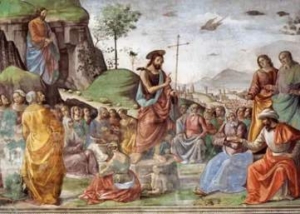
As you slowly read this Gospel passage, allow its words to soak into your mind. You may want to light a candle to help you ponder the passage, reflect on the image above or on the words of Pope Francis below. You might want to imagine that you are in the wilderness listening to John the Baptist and what it means for you to prepare a way for the Lord.
1. What is this passage saying to you?
2. What word(s), sentence or phrase in this Gospel passage most caught your attention; most touched your heart; most challenged you; most comforted you? Is there anything in this passage that you found uncomfortable or startling?
3. ‘Prepare the way of the Lord; make his paths straight.” What are the priorities you need to straighten out during this Advent Season? What is blocking your preparations for the coming of the Lord this Advent.
4. ‘Then Jerusalem and all Judea and all the region about the Jordan were going out to him’. Where do you go to for guidance and inspiration in your faith journey? Who and what inspires you to change your ways?
5. ‘We have Abraham as our father’. Does your creed ever make you think that your salvation is secure? What do you need to surrender to change this viewpoint?
6. ‘He will clear his threshing floor and gather his wheat into the barn’. What is the ‘good fruit’ that those we encounter see in our actions and hear in our words that reflect the message of Jesus? In what ways can you live the word of God more fully in order to produce this good fruit?
Pope Francis tells us:
Advent is a moment of grace to take off our masks – every one of us has them – and line up with those who are humble, to be liberated from the presumption of the belief of being self-sufficient, to go to confess our sins, the hidden ones, and to welcome God’s pardon, to ask forgiveness from those whom we have offended. This is how to begin a new life. There is only one way, the way of humility – to be purified from the sense of superiority, from formalism and hypocrisy, to see ourselves, along with our brothers and sisters, as sinners, and to see Jesus as the Saviour who comes for us, not for the others, for us, just as we are, with our poverty, misery and failings, above all with our need to be raised up, forgiven and saved.
And let us remember one thing: with Jesus, there is always the possibility of beginning again. It’s never too late. There is always the possibility to begin again. Be courageous. He is near to us and this is the time of conversion. Everyone might think: “I have this situation inside, this problem that I am ashamed of”. But Jesus is next to you. Begin again. There is always the possibility of taking a step forward. He is waiting for us and never gets tired of us. He never gets tired! And we are annoying, but he never gets tired! Let us listen to John the Baptist’s appeal to return to God. And let us not let this Advent go by like days on the calendar because this is a moment of grace, a grace for us too, here and now!
We shall now spend 10 minutes reflecting on this scripture passage by reading, repeating, responding and resting as described above. We will then share what we thought, felt etc. only if you are comfortable to do so.
End Prayer
Suscipe of St. Ignatius of Loyola
Take, Lord, and receive all my liberty,
my memory, my understanding,
and my entire will,
All I have and call my own.
You have given all to me.
To you, Lord, I return it.
Everything is yours; do with it what you will.
Give me only your love and your grace,
that is enough for me.
Scripture texts: from the Jerusalem Bible 1966 by Dartington Longman & Todd Ltd and Doubleday and Company Ltd