

By Monica Manser
Lectio Divina – Listening to God’s Word with our hearts
“And the word was made flesh and dwelt amongst us”
In Imaginative Contemplation we pray with the Scriptures, allowing Christ in the Scriptures to speak to us through our imagination. In Lectio Divina we pray with the Scriptures by dwelling on God’s word by listening with our heart. In Imaginative Contemplation, Jesus’ words, actions, teaching and relationships with people become familiar to us when we enter into the Scripture passage using our imagination. In Lectio Divina, God’s word becomes familiar to us by listening with out hearts and dwelling on His words. Listening with our hearts is something we do automatically in everyday life when we for example dwell on the beauty of nature or listening to someone we love or recall a poignant memory.
Lectio Divina or divine reading has four parts: reading, repeating, responding and resting.
Reading: Begin by reading the Scripture Passage slowly until a word or a phrase resonates with you. Then stop for the moment.
Repeating: Dwell on the words you have chosen. Repeat them again and again as though God is saying them to you. Try not to analyse them, just let them speak to you. Savour the words.
Responding: Be like Mary and “ponder these things in your heart”. Allow God’s heart to speak to your heart. He wants to be close to you so ask yourself what this invitation could mean. Speak to God with your heart. Be open to what he is trying to reveal to you. Share with God whatever is coming into your heart and mind.
Resting: Rest in the embrace and love of God. It is God’s response to us. Your whole being is focussed on God so dwell in the moment. When you feel ready, move on.
As you listen to the following passage, note which parts move you but don’t analyse anything. Then when you are ready, read, repeat, respond and rest and when you have dwelt on the words that initially resonated with you, continue on reading the passage and repeat the process.
Prayer
Acknowledge you are in the presence of God by saying the following prayer:
Direct O Lord and guide and influence all that is happening in my mind and heart during this time of prayer: all my moods and feelings, my memories and imaginings; my hopes and desires; may all be directed and influenced to your greater glory, praise and service and to my growth in your Spirit.
Amen
Let the Spirit enter our hearts and enlighten our minds to be open to the different ways we encounter the will of God.
Reading
Matthew 2:13-15, 19-23
When the Magi had departed, behold, an angel of the Lord appeared to Joseph in a dream and said, ‘Rise, take the child and his mother, and flee to Egypt, and remain there until I tell you, for Herod is about to search for the child, to destroy him.’ And he rose and took the child and his mother by night and departed to Egypt and remained there until the death of Herod. This was to fulfil what the Lord had spoken by the prophet: ‘Out of Egypt I called my son.’
But when Herod died, behold, an angel of the Lord appeared in a dream to Joseph in Egypt, saying, ‘Rise, take the child and his mother and go to the land of Israel, for those who sought the child’s life are dead.’ And he rose and took the child and his mother and went to the land of Israel. But when he heard that Archelaus was reigning over Judea in place of his father Herod, he was afraid to go there, and being warned in a dream he withdrew to the district of Galilee. And he went and lived in a city called Nazareth, so that what was spoken by the prophets might be fulfilled, that he would be called a Nazarene.
Questions for reflection
Questions for Reflection
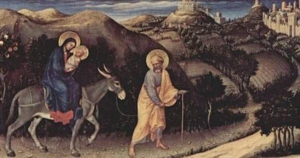
As you slowly read this Gospel passage, allow its words to soak into your mind. You may want to light a candle to help you ponder the passage, reflect on the image above or on the words of Pope Francis below. You might want to recall a significant dream that you have had that changed the course of your life.
1. What is this passage saying to you?
2. What word(s), sentence or phrase in this Gospel passage most caught your attention; most touched your heart; most challenged you; most comforted you? Is there anything in this passage that you found uncomfortable or startling?
3. ‘Behold, an angel of the Lord appeared to Joseph in a dream’. In what ways do you experience the presence of God in your life? Are you responsive to that call? Can you think of the angels in your own life who have guided you through a difficult situation?
4. ‘And he rose and took the child and his mother by night and departed to Egypt’. When have you had to make a life changing decision in your life? How did you feel? How do you treat those who have had to leave their home, their country because of a life changing situation?
5. ‘So that what was spoken by the prophets might be fulfilled.’ What promises has God kept for you? Have you ever been in a difficult situation that has turned into something good? Did this make you more attentive to the will of God?
Pope Francis tells us:
And today the Gospel presents the Holy Family to us on the sorrowful road of exile, seeking refuge in Egypt. Joseph, Mary and Jesus experienced the tragic fate of refugees, which is marked by fear, uncertainty and unease . Unfortunately, in our own time, millions of families can identify with this sad reality. Almost every day the television and papers carry news of refugees fleeing from hunger, war and other grave dangers, in search of security and a dignified life for themselves and for their families.
In distant lands, even when they find work, refugees and immigrants do not always find a true welcome, respect and appreciation for the values they bring. Their legitimate expectations collide with complex and difficult situations which at times seem insurmountable. Therefore, as we fix our gaze on the Holy Family of Nazareth as they were forced to become refugees, let us think of the tragedy of those migrants and refugees who are victims of rejection and exploitation, who are victims of human trafficking and of slave labour. But let us also think of the other “exiles”: I would call them “hidden exiles”, those exiles who can be found within their own families: the elderly for example who are sometimes treated as a burdensome presence. I often think that a good indicator for knowing how a family is doing is seeing how their children and elderly are treated.
End Prayer
Suscipe of St. Ignatius of Loyola
Take, Lord, and receive all my liberty,
my memory, my understanding,
and my entire will,
All I have and call my own.
You have given all to me.
To you, Lord, I return it.
Everything is yours; do with it what you will.
Give me only your love and your grace,
that is enough for me.
Scripture texts: from the Jerusalem Bible 1966 by Dartington Longman & Todd Ltd and Doubleday and Company Ltd