

By Monika Manser
Lectio Divina – Listening to God’s Word with our hearts
“And the word was made flesh and dwelt amongst us”
In Imaginative Contemplation we pray with the Scriptures, allowing Christ in the Scriptures to speak to us through our imagination. In Lectio Divina we pray with the Scriptures by dwelling on God’s word by listening with our heart. In Imaginative Contemplation, Jesus’ words, actions, teaching and relationships with people become familiar to us when we enter into the Scripture passage using our imagination. In Lectio Divina, God’s word becomes familiar to us by listening with out hearts and dwelling on His words. Listening with our hearts is something we do automatically in everyday life when we for example dwell on the beauty of nature or listening to someone we love or recall a poignant memory.
Lectio Divina or divine reading has four parts: reading, repeating, responding and resting.
Reading: Begin by reading the Scripture Passage slowly until a word or a phrase resonates with you. Then stop for the moment.
Repeating: Dwell on the words you have chosen. Repeat them again and again as though God is saying them to you. Try not to analyse them, just let them speak to you. Savour the words.
Responding: Be like Mary and “ponder these things in your heart”. Allow God’s heart to speak to your heart. He wants to be close to you so ask yourself what this invitation could mean. Speak to God with your heart. Be open to what he is trying to reveal to you. Share with God whatever is coming into your heart and mind.
Resting: Rest in the embrace and love of God. It is God’s response to us. Your whole being is focussed on God so dwell in the moment. When you feel ready, move on.
As you listen to the following passage, note which parts move you but don’t analyse anything. Then when you are ready, read, repeat, respond and rest and when you have dwelt on the words that initially resonated with you, continue on reading the passage and repeat the process.
Prayer
Acknowledge you are in the presence of God by saying the following prayer:
Direct O Lord and guide and influence all that is happening in my mind and heart during this time of prayer: all my moods and feelings, my memories and imaginings; my hopes and desires; may all be directed and influenced to your greater glory, praise and service and to my growth in your Spirit.
Amen
Let the Spirit enter our hearts and enlighten our minds to be open to the different ways we encounter the will of God.
Reading
Matthew 1:18-24
Now the birth of Jesus Christ took place in this way. When his mother Mary had been betrothed to Joseph, before they came together she was found to be with child from the Holy Spirit. And her husband Joseph, being a just man and unwilling to put her to shame, resolved to send her away quietly. But as he considered these things, behold, an angel of the Lord appeared to him in a dream, saying, ‘Joseph, son of David, do not fear to take Mary as your wife, for that which is conceived in her is from the Holy Spirit. She will bear a son, and you shall call his name Jesus, for he will save his people from their sins.’
All this took place to fulfil what the Lord had spoken by the prophet:
‘Behold, the virgin shall conceive and bear a son,
and they shall call his name Emmanuel’ —
which means, God with us.
When Joseph woke from sleep, he did as the angel of the Lord commanded him: he took his wife.
Questions for reflection
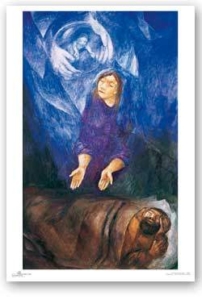
As you slowly read this Gospel passage, allow its words to soak into your mind. You may want to light a candle to help you ponder the passage, reflect on the image above or on the words of Pope Francis below. You might want to recall a significant dream that you have had that changed the course of your life.
1. What is this passage saying to you?
2. What word(s), sentence or phrase in this Gospel passage most caught your attention; most touched your heart; most challenged you; most comforted you? Is there anything in this passage that you found uncomfortable or startling?
3. ‘Her husband Joseph, being a just man and unwilling to put her to shame, resolved to send her away quietly’. What injustices to you see in your community or in a wider context? What small thing can you do to alleviate the injustices that you see in your community or in the world?
4. ‘But as he considered these things, behold, an angel of the Lord appeared to him in a dream.’ Have you ever had a dream that upset your original decision? Can you think of a situation when you were called to look beyond your own understanding and knowledge? How did your logical, practical mind explain such a situation? Can you think of the angels in your own life who have guided you through a difficult situation?
5. ‘‘When Joseph woke from sleep, he did as the angel of the Lord commanded him: he took his wife.’ Do you put your trust in God or your own self knowledge? How do you discern God’s will for you in your life’s journey? Does trusting God make you more open to his plans for you?
Pope Francis tells us:
This Gospel passage reveals to us the greatness of St Joseph’s heart and soul. He was following a good plan for his life, but God was reserving another plan for him, a greater mission. Joseph was a man who always listened to the voice of God, he was deeply sensitive to his secret will, he was a man attentive to the messages that came to him from the depths of his heart and from on high. He did not persist in following his own plan for his life, he did not allow bitterness to poison his soul; rather, he was ready to make himself available to the news that, in a such a bewildering way, was being presented to him. And thus, he was a good man. He did not hate, and he did not allow bitterness to poison his soul. Yet how many times does hatred, or even dislike and bitterness poison our souls! And this is harmful. Never allow it: he is an example of this. And Joseph thereby became even freer and greater. By accepting himself according to God’s design, Joseph fully finds himself, beyond himself. His freedom to renounce even what is his, the possession of his very life, and his full interior availability to the will of God challenge us and show us the way.
End Prayer
Suscipe of St. Ignatius of Loyola
Take, Lord, and receive all my liberty,
my memory, my understanding,
and my entire will,
All I have and call my own.
You have given all to me.
To you, Lord, I return it.
Everything is yours; do with it what you will.
Give me only your love and your grace,
that is enough for me.
Scripture texts: from the Jerusalem Bible 1966 by Dartington Longman & Todd Ltd and Doubleday and Company Ltd