

By Monika Manser
Introduction
The most frequent way of praying that Saint Ignatius uses is that of imagining ourselves in a Gospel scene. We imagine ourselves as a character in the story. We take part in the story, seeing Jesus and all the other people, being aware of what’s going on and how we are feeling. The purpose of praying with the imagination is to allow Christ in the Scripture to speak to us. To bring the Gospel stories to life for us. We are not trying to recreate history. It doesn’t matter if your imagination takes the story off in a different direction to the Scripture. It doesn’t matter if the story takes place in 1st century Palestine or where we live now in the 21st century. What is important is what God wants to say to us through this passage.
Let us sit and relax so that together we can contemplate the Gospel using our imagination.
Prayer
We acknowledge we are in the presence of God so let us say together:
Direct O Lord and guide and influence all that is happening in my mind and heart during this time of prayer: all my moods and feelings, my memories and imaginings; my hopes and desires; may all be directed and influenced to your greater glory, praise and service and to my growth in your Spirit.
Amen
Let the Spirit enter our hearts and enlighten our minds as we relax in the company of Jesus and share a meal. Let the Spirit enrich our hearts and minds so that we can contemplate this great miracle of the feeding of the five thousand.
Reading
Matthew 14:13-21
At that time: When Jesus heard of the death of John the Baptist, he withdrew in a boat to a desolate place by himself. But when the crowds heard it, they followed him on foot from the towns. When he went ashore he saw a great crowd, and he had compassion on them and healed their sick.
Now when it was evening, the disciples came to him and said, ‘This is a desolate place, and the day is now over; send the crowds away to go into the villages and buy food for themselves.’ But Jesus said, ‘They need not go away; you give them something to eat.’ They said to him, ‘We have only five loaves here and two fish.’ And he said, ‘Bring them here to me.’ Then he ordered the crowds to sit down on the grass, and taking the five loaves and the two fish, he looked up to heaven and said a blessing. Then he broke the loaves and gave them to the disciples, and the disciples gave them to the crowds. And they all ate and were satisfied.
And they took up twelve baskets full of the broken pieces left over. And those who ate were about five thousand men, besides women and children.
Contemplation
In the previous verses of this chapter, we hear of the arrest and beheading of Jesus’ cousin, John the Baptist. Jesus needs time to grieve and seeks some time to be alone. As we enter this scene, a scene of crowdedness, let the Spirit enter our hearts so that we too can be like Jesus and have a generous heart, putting others first before ourselves.
-
Who are you in the scene? One of the disciples? One of the crowd who has travelled all day to see Jesus? Someone who had just happened to be there? An inanimate object? Or you could be one of the loaves or the fishes.
-
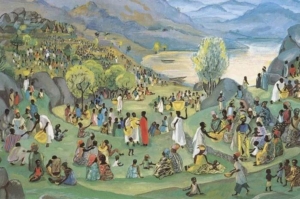
Imagine the landscape around the Sea of Galilee. Feel the dry grass under your feet and the warmth of the late afternoon sun on your skin. Feel the cooling breeze brushing on your face. Hear the murmur of the massive crowd—the chatter, the crying children, and the rustle of clothing. Watch Jesus and his disciples coming ashore in a boat.
- Jesus has just heard that His cousin, John the Baptist, has been executed. Look at his face as He steps off the boat. Does he look sad? Imagine how he is wanting solitude to mourn, yet He is met with this all the people. Watch how His grief transforms into deep, compassion. He does not turn them away; He begins healing them.
- Listen to the disciples approach Jesus as darkness falls. Hear the panic or practicality in their voices: “Dismiss the crowds so they can buy food.” Watch their stunned expressions when Jesus replies: “You give them something to eat.” Feel the tension as they bring forward a small offering—five flat barley loaves and two small, salted fish. What is going through your mind at this point?
- Watch Jesus command everyone to sit down. He takes the loaves and fish into His hands. Look at His eyes as He raises them to heaven, completely untroubled by the massive deficit, and says the blessing. Hear the distinct sound of the bread tearing as He breaks it and hands it to the disciples.
- If you are a disciple, feel the weight of the basket in your hands. Notice how every time you reach in to pull out a piece of bread or fish, there is always more underneath. If you are in the crowd, watch the basket approach you. Take a piece.
- Taste the bread. What does it taste like? is it surprisingly warm, fresh, and sweet? Feel the change in the atmosphere from anxious desperation to profound, joyful relief as thousands of people realise they are safe and cared for.
- How do you react to this miracle? What impact does this miracle you are witnessing, being a part of, make on your life? Has your hunger been satisfied or has this miracle left you hungry for more? Do you see this as a gift from God?
- Watch the disciples walk the hillside again, carrying twelve massive wicker baskets, now piled high with broken, left-over fragments. Do you realise that Jesus does not just meet minimum needs; He leaves a surplus.
- You have just experienced God’s love for his people and He has given you a gift. Do you want to share this gift? Are you now encouraged to cater for the needs of others around you or further afield?
As the crowd begins to settle or leave, imagine yourself walking up to Jesus. Sit with Him on the grass. Speak to Him straight from your heart. Tell him what you need him to provide for you right now. Tell him about your own feelings of inadequacy when faced with overwhelming tasks.
Contemplate on the abundant ways he provides for your needs in your daily life
Sharing
Let us now share what we thought, felt etc. only if you are comfortable to do so.
End Prayer
Suscipe of St. Ignatius of Loyola
Take, Lord, and receive all my liberty,
my memory, my understanding,
and my entire will,
All I have and call my own.
You have given all to me.
To you, Lord, I return it.
Everything is yours; do with it what you will.
Give me only your love and your grace,
that is enough for me.
Scripture texts: from the Jerusalem Bible 1966 by Dartington Longman & Todd Ltd and Doubleday and Company Ltd