

By Monika Manser
Introduction
The most frequent way of praying that Saint Ignatius uses is that of imagining ourselves in a Gospel scene. We imagine ourselves as a character in the story. We take part in the story, seeing Jesus and all the other people, being aware of what’s going on and how we are feeling. The purpose of praying with the imagination is to allow Christ in the Scripture to speak to us. To bring the Gospel stories to life for us. We are not trying to recreate history. It doesn’t matter if your imagination takes the story off in a different direction to the Scripture. It doesn’t matter if the story takes place in 1st century Palestine or where we live now in the 21st century. What is important is what God wants to say to us through this passage.
Let us sit and relax so that together we can contemplate the Gospel using our imagination.
Prayer
We acknowledge we are in the presence of God so let us say together:
Direct O Lord and guide and influence all that is happening in my mind and heart during this time of prayer: all my moods and feelings, my memories and imaginings; my hopes and desires; may all be directed and influenced to your greater glory, praise and service and to my growth in your Spirit.
Amen
Let the Spirit guide and enlighten your mind as we ask for the grace to journey with Jesus during this Holy Week.
Reading
Matthew 21:1-11
When Jesus and his disciples drew near to Jerusalem and came to Bethphage, to the Mount of Olives, then Jesus sent two disciples, saying to them, ‘Go into the village in front of you, and immediately you will find a donkey tied, and a colt with her. Untie them and bring them to me. If anyone says anything to you, you shall say, “The Lord needs them”, and he will send them at once.’ This took place to fulfil what was spoken by the prophet, saying,
‘Say to the daughter of Sion,
“Behold, your king is coming to you,
humble, and mounted on a donkey,
on a colt, the foal of a beast of burden.”’
The disciples went and did as Jesus had directed them. They brought the donkey and the colt and put on them their cloaks, and he sat on them. Most of the crowd spread their cloaks on the road, and others cut branches from the trees and spread them on the road. And the crowds that went before him and that followed him were shouting, ‘Hosanna to the Son of David! Blessed is he who comes in the name of the Lord. Hosanna in the highest!’ And when he entered Jerusalem the whole city was stirred up, saying, ‘Who is this?’ And the crowds said, ‘This is the prophet Jesus, from Nazareth of Galilee.’
Contemplation
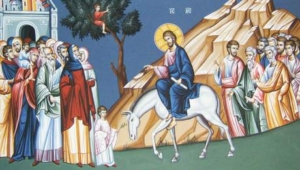
Today, Palm Sunday, we enter Holy week starting with Jesus’ triumphal entry into Jerusalem. Holy Week is the climax of the Lent, as we journey with Jesus towards the feast of Easter. Jesus mounts a colt and begins his journey to Jerusalem amidst a crowd singing from Psalm 117. With this in mind, imagine the scene, find a place within it. With the help of the Spirit, let the story unfold in your imagination.
• Who are you within the story? Are you one of the disciples fetching the colt? One of the crowd welcoming the King? A curious onlooker? Perhaps you are the colt on which Jesus is sitting? Perhaps you are someone or something not mentioned in the passage?
• Focus on the location: the road from the Mount of Olives descending toward Jerusalem, with the city’s stone walls and the Temple gleaming in the distance. What do you notice?
• Feel the heat of the midday sun on your skin and the press of the crowd around you. Where are you within the crowd? Smell the dry dust of the road, the scent of crushed greenery, and the animal smells of the donkey and colt. What is the atmosphere like? Is it full of tension, anticipation, excitement?
• Notice the disciples walking to fetch the colt. How do you think they might feel? Perhaps a feeling of foreboding remembering Jesus’ recent warnings about his coming death. Perhaps a feeling of wonder as they carry out the unusual instructions.
• See the dust rising from the road as the large crowd gathers. Notice the vibrant colours of the cloaks being thrown onto the dirt and the bright green of the freshly cut palm branches. Observe Jesus riding a humble donkey. Contrast it with the pomp of Roman military parades.
• Can you imagine being there with Jesus as he is about to enter Jerusalem? How do you feel? Do you feel the impulse to put your garments on this beast of burden for Jesus to sit on and on the road ahead of Jesus? Why? Do you feel that Jesus deserves a triumphal entry into Jerusalem? That everyone should know he is coming?
• Do you wonder why Jesus was making his journey on a colt? Do you wonder if it was to show that he was entering the city in peace as opposed to a conquering king?
• Hear the rhythmic chanting of “Hosanna to the Son of David!” and “Blessed is he who comes in the name of the Lord!”. Listen for the rustling of palm branches, the braying of the donkey.
• Are you waving a palm? What do you want to shout as Jesus passes by? Are you too singing Hosanna?
• What do you notice about the crowd around you? Are they excited? Hysterical? Joyful?
• What do you notice about the disciples following Jesus? What look do they have on their faces? Excited? Proud?
• What do you notice about Jesus? Is he showing any emotion? Is he calm, purposeful, yet knowingly approaching his passion, riding on a donkey’s colt?
• At the height of the scene, imagine Jesus looking directly at you. Does he look like a conquering king, or do you see the weight of the coming “Passion Week” in his eyes? What do you want to say to him in this moment of praise? What do you need to ask him?
• Notice the reaction of those in Jerusalem—confusion and curiosity, as the whole city is moved. You might be a city dweller or a religious leader, feeling agitated or unnerved by the commotion this Galilean prophet is causing.
Is there anything you want to say to Jesus about what you have just witnessed or been part of? Tell him how you feel.
Sharing
Let us now share what we thought, felt etc. only if you are comfortable to do so.
End Prayer
Suscipe of St. Ignatius of Loyola
Take, Lord, and receive all my liberty,
my memory, my understanding,
and my entire will,
All I have and call my own.
You have given all to me.
To you, Lord, I return it.
Everything is yours; do with it what you will.
Give me only your love and your grace,
that is enough for me.
Scripture texts: from the Jerusalem Bible 1966 by Dartington Longman & Todd Ltd and Doubleday and Company Ltd