

By Monika Manser
Introduction
The most frequent way of praying that Saint Ignatius uses is that of imagining ourselves in a Gospel scene. We imagine ourselves as a character in the story. We take part in the story, seeing Jesus and all the other people, being aware of what’s going on and how we are feeling. The purpose of praying with the imagination is to allow Christ in the Scripture to speak to us. To bring the Gospel stories to life for us. We are not trying to recreate history. It doesn’t matter if your imagination takes the story off in a different direction to the Scripture. It doesn’t matter if the story takes place in 1st century Palestine or where we live now in the 21st century. What is important is what God wants to say to us through this passage.
Let us sit and relax so that together we can contemplate the Gospel using our imagination.
Prayer
We acknowledge we are in the presence of God so let us say together:
Direct O Lord and guide and influence all that is happening in my mind and heart during this time of prayer: all my moods and feelings, my memories and imaginings; my hopes and desires; may all be directed and influenced to your greater glory, praise and service and to my growth in your Spirit.
Amen
Let the Spirit enter our hearts and enlighten our minds as we listen to and reflect on the Transfiguration of Jesus. Let us follow Jesus up the mountain so that we too can witness the his divinity.
Reading
Matthew 17: 1-9
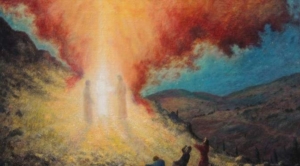
At that time: Jesus took with him Peter and James and John his brother, and led them up a high mountain by themselves. And he was transfigured before them, and his face shone like the sun, and his clothes became white as light. And behold, there appeared to them Moses and Elijah, talking with him.
And Peter said to Jesus, ‘Lord, it is good that we are here. If you wish, I will make three tents here, one for you and one for Moses and one for Elijah.’ He was still speaking when, behold, a bright cloud overshadowed them, and a voice from the cloud said, ‘This is my beloved Son, with whom I am well pleased; listen to him.’ When the disciples heard this, they fell on their faces and were terrified.
But Jesus came and touched them, saying, ‘Rise, and have no fear.’ And when they lifted up their eyes, they saw no one, but Jesus only. And as they were coming down the mountain, Jesus commanded them, ‘Tell no one the vision, until the Son of Man is raised from the dead.’
Contemplation
Every year on the Second Sunday of Lent, we read the account of the Transfiguration of Jesus. It is reported in the Gospels of Matthew, Mark and Luke and this year, Year A of the lectionary, we hear from the account of St Matthew. Let us join Jesus on the mountain with Peter, James and John and watch the scene unfold.
• Who are you within the story? Are you Peter, James or John, or an unnoticed bystander? Are you maybe a person or thing that is not specially mentioned in the printed story?
• Imagine the physical strain of climbing. Feel the rough soil under your feet, the steepness of the incline, and the thinning air as you climb away from the world below.
• What time of day is it? Is there a breeze? Is it hot, cool, or oppressive? Notice the silence of the mountain compared to the crowds you left behind.
• Are you tired from the walk up the high mountain? What can you see, hear and feel around you as you are walking? What is the location/scenery like? Is the hill steep?
• What are the sounds, the smells, and the other details about the location that you notice? Are there any animals or vegetation?
• Are you interacting with those around you, or are you walking by yourself, or following at a distance? How is Jesus interacting with his friends or you?
• Where do you stop? Watch Jesus kneel down to pray. What expression does he have? Witness Jesus as his face starts to shine like the sun and his clothes become dazzling white. See Moses and Elijah standing beside him, representing the Law and the Prophets. Feel the overwhelming awe at the appearance of Moses and Elijah. Notice the fear, the confusion, and the sheer brightness that surrounds you.
• Listen to the conversation between Jesus and the two prophets. How is Jesus interacting with them? Can you hear what is being said?
• Listen to Peter’s stumbling, frightened words, trying to make sense of the scene. What are you feeling? Are you confused like Peter, wanting to build shelters to stay in this “mountain-top experience”? Have you ever had a mountain-top experience that you have not wanted to end?
• Experience the sudden, thick, bright cloud enveloping you and the surroundings. Hear the voice of God, echoing in the silence: “This is my Son, the Beloved; with him I am well pleased. Listen to him!”. Feel the fear that causes the disciples to fall to the ground, trembling.
• Imagine the gentle voice of Jesus touching you and saying, “Stand up and do not be afraid? Can you recall a time when you have heard the comforting voice of Jesus?
• Walk down the mountain with Jesus, contemplating the weight of the experience and what it means to truly listen to him.
Talk to Jesus about what you have just seen? Tell him about the fears in your life where you need to feel his touch and hear the words, “Do not be afraid”? Talk to him about the ways you can better “listen to him” in your daily life?
Sharing
Let us now share what we thought, felt etc. only if you are comfortable to do so.
End Prayer
Suscipe of St. Ignatius of Loyola
Take, Lord, and receive all my liberty,
my memory, my understanding,
and my entire will,
All I have and call my own.
You have given all to me.
To you, Lord, I return it.
Everything is yours; do with it what you will.
Give me only your love and your grace,
that is enough for me.
Scripture texts: from the Jerusalem Bible 1966 by Dartington Longman & Todd Ltd and Doubleday and Company Ltd