

By Monika Manser
Introduction
The most frequent way of praying that Saint Ignatius uses is that of imagining ourselves in a Gospel scene. We imagine ourselves as a character in the story. We take part in the story, seeing Jesus and all the other people, being aware of what’s going on and how we are feeling. The purpose of praying with the imagination is to allow Christ in the Scripture to speak to us. To bring the Gospel stories to life for us. We are not trying to recreate history. It doesn’t matter if your imagination takes the story off in a different direction to the Scripture. It doesn’t matter if the story takes place in 1st century Palestine or where we live now in the 21st century. What is important is what God wants to say to us through this passage.
Let us sit and relax so that together we can contemplate the Gospel using our imagination.
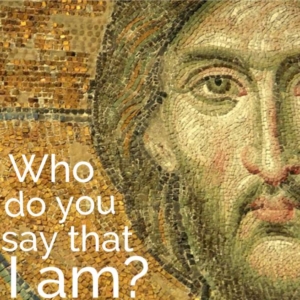
Prayer
We acknowledge we are in the presence of God so let us say together:
Direct O Lord and guide and influence all that is happening in my mind and heart during this time of prayer: all my moods and feelings, my memories and imaginings; my hopes and desires; may all be directed and influenced to your greater glory, praise and service and to my growth in your Spirit.
Amen
As you listen to Jesus with his disciples, let the Spirit enter your heart and mind so that when Jesus asks you the question “Who do you say I am?” you can answer with the same conviction as Peter “You are the Christ, the Son of the Living God”.
Reading
Matthew 16:13-20
At that time: When Jesus came into the district of Caesarea Philippi, he asked his disciples, ‘Who do people say that the Son of Man is?’ And they said, ‘Some say John the Baptist, others say Elijah, and others Jeremiah or one of the prophets.’ He said to them, ‘But who do you say that I am?’
Simon Peter replied, ‘You are the Christ, the Son of the living God.’ And Jesus answered him, ‘Blessed are you, Simon Bar-Jonah! For flesh and blood has not revealed this to you, but my Father who is in heaven. And I tell you, you are Peter, and on this rock I will build my Church, and the gates of hell shall not prevail against it. I will give you the keys of the kingdom of heaven, and whatever you bind on earth shall be bound in heaven, and whatever you loose on earth shall be loosed in heaven.’
Then he strictly charged the disciples to tell no one that he was the Christ.
Contemplation
Today, on the 21st Sunday in Ordinary time, let us start our contemplation by setting the scene. Jesus is journeying with his disciples to Caesarea Philippi which is located along the southern slopes of Mount Hermon and is the source of the River Jordan. The area dominated by a massive wall of rock. Carved directly into the cliff faces are shrines to pagan gods like Pan. With this in mind, and with the help of the Spirit, find a place within this passage and amidst the beauty of the location and contemplate “Who is Jesus to you?”
- Who are you within the story? Are you one of the Twelve? Perhaps a passer-by? On looker? Or someone who is not mentioned in the passage.
- Picture the dry, dusty foothills near the massive stone cliffs of Caesarea Philippi, surrounded by shrines of old powers and pagan temples.
- Feel the warm Mediterranean sun on your shoulders, the crunch of gravel beneath your sandals, and the voices of the other disciples chattering as they are walking. Listen to the constant, distant rush of water from the springs feeding the Jordan River.
- Where does Jesus settle down to talk to you? In the temple dedicated to Caesar? At the source of the Jordan? Or are you sitting on one of the rocks?
- When he asks you “Who do people say the Son of Man is?” Are you the one who replies “Elijah” or “John the Baptist” or “one of the prophets” or do you sit quietly listening to everyone else? Do the disciples look relieved because they are shouting out out safe, secondhand opinions. Do they look animated because they are sharing the latest news?
- Imagine Jesus stepping closer and looking directly into the eyes of his disciples – and then looking directly at you. His tone softens but deepens: “But who do you say that I am?” Imagine the silence that follows. No one wants to make a mistake. Feel the weight of that silence. Do you find it difficult to put into your own words thus you are glad that Simon Peter spoke first?
- Watch Simon Peter as he steps forward and declares with clarity “You are the Messiah, the Son of the living God”. Look at the expressions on the other disciples’ faces. Do they look surprised, filled with awe and relief?
- Do you wonder what it is about Jesus that makes Simon Peter answer as he did? Do you think it was an answer that came from his heart?
- What is Jesus’ reaction at Simon Peter’s declaration of faith? Watch Jesus’ expression transform. A joyful smile breaks across his face.
- When Jesus says that it is his Father in heaven who has revealed Simon Peter’s outpouring of faith, how does it make you feel?
- How do you think it made Simon Peter feel when when Jesus renamed him Peter and said that he would build his Church on him? That he would give him the keys of the Kingdom of heaven? Listen quietly for what Jesus wants to say back to you, or what new name and purpose he wants to give you.
- Jesus now turns his gaze back to you and walks over to where you are standing, and looks at you with love. He asks you the exact same question: “Who do you say that I am?”
- Take a moment to speak to him from your heart, What is your honest answer to him today? Is he a historical teacher, a comfort, a challenge, your saviour or something else?
- Is there anything you want to say to Jesus? Do you perhaps want to ask him who you are in his eyes?
Let us sit with Jesus for 10 minutes and imagine the scene and perhaps tell Him what keeps you from fully knowing or naming Him in your daily life. Tell him about the worldly pressures in your own life that make it hard to confess him openly. We will then share our thoughts if we are comfortable to do so.
Sharing
Let us now share what we thought, felt etc. only if you are comfortable to do so.
End Prayer
Suscipe of St. Ignatius of Loyola
Take, Lord, and receive all my liberty,
my memory, my understanding,
and my entire will,
All I have and call my own.
You have given all to me.
To you, Lord, I return it.
Everything is yours; do with it what you will.
Give me only your love and your grace,
that is enough for me.
Scripture texts: from the Jerusalem Bible 1966 by Dartington Longman & Todd Ltd and Doubleday and Company Ltd