

By Monika Manser
Introduction
The most frequent way of praying that Saint Ignatius uses is that of imagining ourselves in a Gospel scene. We imagine ourselves as a character in the story. We take part in the story, seeing Jesus and all the other people, being aware of what’s going on and how we are feeling. The purpose of praying with the imagination is to allow Christ in the Scripture to speak to us. To bring the Gospel stories to life for us. We are not trying to recreate history. It doesn’t matter if your imagination takes the story off in a different direction to the Scripture. It doesn’t matter if the story takes place in 1st century Palestine or where we live now in the 21st century. What is important is what God wants to say to us through this passage.
Let us sit and relax so that together we can contemplate the Gospel using our imagination.
Prayer
We acknowledge we are in the presence of God so let us say together:
Direct O Lord and guide and influence all that is happening in my mind and heart during this time of prayer: all my moods and feelings, my memories and imaginings; my hopes and desires; may all be directed and influenced to your greater glory, praise and service and to my growth in your Spirit.
Amen
Let the Spirit guide and enlighten our minds as we read the Gospel and reflect on what it means to have Jesus appear in our midst. Let us pray that we recognise him.
Reading
Luke 24: 13-35
On the first day of the week, two of the disciples of Jesus were going to a village named Emmaus, about seven miles from Jerusalem, and they were talking with each other about all these things that had happened. While they were talking and discussing together, Jesus himself drew near and went with them. But their eyes were kept from recognising him. And he said to them, ‘What is this conversation that you are holding with each other as you walk?’ And they stood still, looking sad. Then one of them, named Cleopas, answered him, ‘Are you the only visitor to Jerusalem who does not know the things that have happened there in these days?’ And he said to them, ‘What things?’ And they said to him, ‘Concerning Jesus of Nazareth, a man who was a prophet mighty in deed and word before God and all the people, and how our chief priests and rulers delivered him up to be condemned to death, and crucified him. But we had hoped that he was the one to redeem Israel. Yes, and besides all this, it is now the third day since these things happened. Moreover, some women of our company amazed us. They were at the tomb early in the morning, and when they did not find his body, they came back saying that they had even seen a vision of angels, who said that he was alive. Some of those who were with us went to the tomb and found it just as the women had said, but him they did not see.’ And he said to them, ‘O foolish ones, and slow of heart to believe all that the prophets have spoken! Was it not necessary that the Christ should suffer these things and enter into his glory?’ And beginning with Moses and all the Prophets, he interpreted to them in all the Scriptures the things concerning himself.
So they drew near to the village to which they were going. He acted as if he were going farther, but they urged him strongly, saying, ‘Stay with us, for it is towards evening and the day is now far spent.’ So he went in to stay with them. When he was at table with them, he took the bread, and blessed, and broke it, and gave it to them. And their eyes were opened, and they recognised him. And he vanished from their sight. They said to each other, ‘Did not our hearts burn within us while he talked to us on the road, while he opened to us the Scriptures?’ And they rose that same hour and returned to Jerusalem. And they found the Eleven and those who were with them gathered together, saying, ‘The Lord has risen indeed, and has appeared to Simon!’ Then they told what had happened on the road, and how he was known to them in the breaking of the bread.
Contemplation
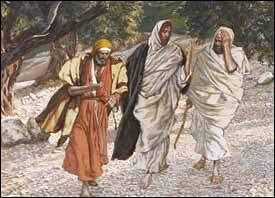
In today’s Gospel, the 3rd Sunday of Easter, we hear of another encounter by the Risen Christ, this time from the Gospel of Luke. Imagine the scene on the road to Emmaus, find a place within it. With the help of the Spirit, let the story unfold in your imagination.
- Who are you within the story? Are you one of the two disciples (perhaps Cleopas or his unnamed companion), or are you a third traveller walking alongside them? Or one of the disciples assembled together hearing the testimony of these two witnesses? Perhaps a person that is not specially mentioned in the printed story?
- What time of day is it? What does the road look like as you walk along? Is it dusty, rocky, or damp? See the two disciples—Cleopas and his companion. What are they wearing? What do you see in the distance—hills, crops, small houses?
- Walk with the two disciples as they set out. Hear the rhythm of the footsteps and the low, heavy tone of voices as you discuss the tragedy in Jerusalem.
- Feel the fatigue in your legs after walking miles. What are you discussing as you walk along? Are you trying to make sense of what has just happened?
- Notice how you are feeling? Do you feel downcast. sad, grieving because your friend and leader has been crucified? Feel the weight of hopelessness, disappointment, despair, anger, frustration, disillusionment because you had hoped that the Messiah, Jesus, your friend had come to bring freedom from the tyranny of the foreign occupation of Israel. Do you feel unsure of what to do next?
- Notice the stranger joining you. Notice his face and the way he walks. Listen as he asks why you are downcast. Hear the disciples pour out their confusion: “We had hoped he was the one…”. Do you feel better when you have poured out your story to this stranger who listens attentively?
- Listen as the stranger begins to explain the Scriptures, starting with Moses and the Prophets. How do you feel as he speaks? Do you feel your “heart beginning to burn within you”? What is going through your head as this stranger explains in a different way what has happened and why Christ had to die. Does it give you a different point of view? Do the events of the past few days begin to make sense?
- What was about the stranger that made you invite him in to share your meal? Was it because he lifted your spirits by making sense of the crucifixion of your friend? Was it because he was a good listener? Recall the times in your life when you have met fellow traveller who has made you feel better about your situation? Think about times when you have poured out your soul to a stranger and they have helped you see things in a new light?
- How did you feel when you recognised that it was Jesus in your midst? Why did you not recognise him before the breaking of bread? Do you recognise Jesus accompanying you in the experiences of your life, helping you make sense of what happens?
- Feel the sudden surge of energy as you and your companion immediately set out to run the seven miles back to Jerusalem to tell the others. What was their reaction?
Sit and imagine the scene and talk to Jesus. Ask him to show his face in those you walk with in your every day encounters. Ask him to stay with you as “It is nearly evening and the day is almost over”.
We will sit with our thoughts and imagination for 10 minutes
Sharing
Let us now share what we thought, felt etc. only if you are comfortable to do so.
End Prayer
Suscipe of St. Ignatius of Loyola
Take, Lord, and receive all my liberty,
my memory, my understanding,
and my entire will,
All I have and call my own.
You have given all to me.
To you, Lord, I return it.
Everything is yours; do with it what you will.
Give me only your love and your grace,
that is enough for me.
Scripture texts: from the Jerusalem Bible 1966 by Dartington Longman & Todd Ltd and Doubleday and Company Ltd