

By Monika Manser
Introduction
The most frequent way of praying that Saint Ignatius uses is that of imagining ourselves in a Gospel scene. We imagine ourselves as a character in the story. We take part in the story, seeing Jesus and all the other people, being aware of what’s going on and how we are feeling. The purpose of praying with the imagination is to allow Christ in the Scripture to speak to us. To bring the Gospel stories to life for us. We are not trying to recreate history. It doesn’t matter if your imagination takes the story off in a different direction to the Scripture. It doesn’t matter if the story takes place in 1st century Palestine or where we live now in the 21st century. What is important is what God wants to say to us through this passage.
Let us sit and relax so that together we can contemplate the Gospel using our imagination.
Prayer
We acknowledge we are in the presence of God so let us say together:
Direct O Lord and guide and influence all that is happening in my mind and heart during this time of prayer: all my moods and feelings, my memories and imaginings; my hopes and desires; may all be directed and influenced to your greater glory, praise and service and to my growth in your Spirit.
Amen
Let the Spirit enter our heart and enlighten our minds as we listen to and reflect on Jesus curing the blind man. Let us too wash in the pool of Siloam so that our eyes can be opened to the goodness of God.
Reading
John 9:1-41. (Abridged)
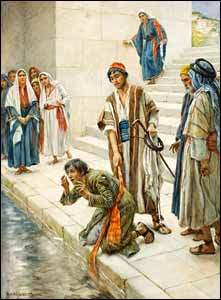
At that time: As Jesus passed by, he saw a man blind from birth. He spat on the ground and made mud with the saliva. Then he anointed the man’s eyes with the mud and said to him, ‘Go, wash in the pool of Siloam’ (which means Sent). So he went and washed and came back seeing.
The neighbours and those who had seen him before as a beggar were saying, ‘Is this not the man who used to sit and beg?’ Some said, ‘It is he.’ Others said, ‘No, but he is like him.’ He kept saying, ‘I am the man.’
They brought to the Pharisees the man who had formerly been blind. Now it was a Sabbath day when Jesus made the mud and opened his eyes. So the Pharisees again asked him how he had received his sight. And he said to them, ‘He put mud on my eyes, and I washed, and I see.’ Some of the Pharisees said, ‘This man is not from God, for he does not keep the Sabbath.’ But others said, ‘How can a man who is a sinner do such signs?’ And there was a division among them. So they said again to the blind man, ‘What do you say about him, since he has opened your eyes?’ He said, ‘He is a prophet.’ They answered him, ‘You were born in utter sin, and would you teach us?’ And they cast him out.
Jesus heard that they had cast him out, and having found him he said, ‘Do you believe in the Son of Man?’ He answered, ‘And who is he, sir, that I may believe in him?’ Jesus said to him, ‘You have seen him, and it is he who is speaking to you.’ He said, ‘Lord, I believe’, and he worshipped him.
Contemplation
Imagine the scene and find a place within it. With the help of the Spirit, let the story unfold in your imagination.
• Who are you within the story? The blind man,? One of his neighbours? One of his disciples? One of the Pharisees? One of his friends or an unnoticed bystander? You may be a person or thing that is not specifically mentioned in the printed story?
• Imagine you are walking along the dusty road outside the Temple in Jerusalem. What time of day is it? What is the atmosphere like? Hot? Oppressive? Crowded? Noisy?
• Notice the man born blind sitting in the shadows of a wall, his hand outstretched for alms. Do you know him, either personally or by sight? Have you ever spoken to him? Do you give the blind man alms? Listen to the bustling crowd, the clinking of coins. How do people react towards this man?
• Who is there? How do they interact? Look around you and notice the expressions on people’s faces. Listen to the tone of their voices and what is being said.
• Watch as Jesus spits on the ground and makes mud. Feel the cool, gritty texture as He spreads it over the man’s eyes. How do you think the blind man felt?
• Did someone guide him to the pool at Siloam so that he could carry out Jesus’ instructions to bathe his eyes? Or was it a stumbling journey guided by faith?
• If you are the man, what do you feel in this moment of strange, silent contact? Are you willing to go and “wash,” following Jesus’ instructions even when they seem strange?
• Imagine the shock of the first splash of water and the sudden explosion of light and colour. What is the first thing the man sees?. Have you ever experienced coming out of the darkness and into the light?
• Are you with the crowd who brought the blind man to the Pharisees? Witness the growing tension as the Pharisees question the man. Observe their suspicion and the man’s increasing boldness as he stands his ground. How do you feel about their reaction and aggression towards the blind man’s cure? Do you ever act like the Pharisees, thinking you “see” while remaining in darkness?
• Notice that the blind man has not only received his sight but also the courage to acknowledge that Jesus is responsible for his cure. That he fearlessly acknowledges that Jesus is a prophet. Do you admire him for his courage? Do you feel sorry for him because the Pharisees drove him out – separated from his family and community? Have you ever been driven out for what you believe?
• Watch Jesus as he seeks out the blind man. What is it like for him as he now sees Jesus and believes? Listen to the conversation that takes place between them. How do you react at the blind man’s profession of faith? Has there ever been an incidence in your life that has made you say “Lord, I believe.?”
• Is there anyone you want to engage in conversation?
Ask Jesus to give you the courage to witness to your faith. Talk to him about the ways you are blind and ask him to open your eyes to enable you to see God’s face in everyone you meet and his goodness in every day life..
We will sit with these thoughts and imaginations for 10 minutes
Sharing
Let us now share what we thought, felt etc. only if you are comfortable to do so.
End Prayer
Suscipe of St. Ignatius of Loyola
Take, Lord, and receive all my liberty,
my memory, my understanding,
and my entire will,
All I have and call my own.
You have given all to me.
To you, Lord, I return it.
Everything is yours; do with it what you will.
Give me only your love and your grace,
that is enough for me.
Scripture texts: from the Jerusalem Bible 1966 by Dartington Longman & Todd Ltd and Doubleday and Company Ltd