

By Monika Manser
Introduction
The most frequent way of praying that Saint Ignatius uses is that of imagining ourselves in a Gospel scene. We imagine ourselves as a character in the story. We take part in the story, seeing Jesus and all the other people, being aware of what’s going on and how we are feeling. The purpose of praying with the imagination is to allow Christ in the Scripture to speak to us. To bring the Gospel stories to life for us. We are not trying to recreate history. It doesn’t matter if your imagination takes the story off in a different direction to the Scripture. It doesn’t matter if the story takes place in 1st century Palestine or where we live now in the 21st century. What is important is what God wants to say to us through this passage.
Let us sit and relax so that together we can contemplate the Gospel using our imagination.
Prayer
We acknowledge we are in the presence of God so let us say together:
Direct O Lord and guide and influence all that is happening in my mind and heart during this time of prayer: all my moods and feelings, my memories and imaginings; my hopes and desires; may all be directed and influenced to your greater glory, praise and service and to my growth in your Spirit.
Amen
Let the Spirit enter our hearts and enlighten our minds so that we may discern which are the voices that speak the truth to us.
Reading
John 4:5-42 (Abridged)
At that time: Jesus came to a town of Samaria called Sychar, near the field that Jacob had given to his son Joseph. Jacob’s well was there; so Jesus, wearied as he was from his journey, was sitting beside the well. It was about the sixth hour.
A woman from Samaria came to draw water. Jesus said to her, ‘Give me a drink.’ (For his disciples had gone away into the city to buy food.) The Samaritan woman said to him, ‘How is it that you, a Jew, ask for a drink from me, a woman of Samaria?’ (For Jews have no dealings with Samaritans.) Jesus answered her, ‘If you knew the gift of God, and who it is that is saying to you, “Give me a drink”, you would have asked him, and he would have given you living water.’ The woman said to him, ‘Sir, you have nothing to draw water with, and the well is deep. Where do you get that living water? Are you greater than our father Jacob? He gave us the well and drank from it himself, as did his sons and his livestock.’ Jesus said to her, ‘Everyone who drinks of this water will be thirsty again, but whoever drinks of the water that I will give him will never be thirsty again. The water that I will give him will become in him a spring of water welling up to eternal life.’ The woman said to him, ‘Sir, give me this water, so that I will not be thirsty or have to come here to draw water. Sir, I perceive that you are a prophet. Our fathers worshipped on this mountain, but you say that in Jerusalem is the place where people ought to worship.’ Jesus said to her, ‘Woman, believe me, the hour is coming when neither on this mountain nor in Jerusalem will you worship the Father. You worship what you do not know; we worship what we know, for salvation is from the Jews. But the hour is coming, and is now here, when the true worshippers will worship the Father in spirit and truth, for the Father is seeking such people to worship him. God is spirit, and those who worship him must worship in spirit and truth.’ The woman said to him, ‘I know that Messiah is coming — he who is called Christ. When he comes, he will tell us all things.’ Jesus said to her, ‘I who speak to you am he.’
Many Samaritans from that town believed in him. So when the Samaritans came to him, they asked him to stay with them, and he stayed there two days. And many more believed because of his word. They said to the woman, ‘It is no longer because of what you said that we believe, for we have heard for ourselves, and we know that this is indeed the Saviour of the world.’
Contemplation
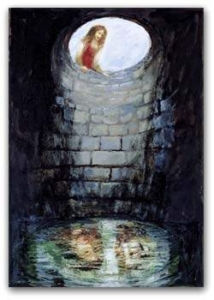
Imagine the scene, find a place within it. With the help of the Spirit, take time to explore imaginatively this intimate meeting between Jesus and the Samaritan woman at the well.
• Who are you within the story? Are you the tired traveler in need of rest and water? A lone women in need of friendship? A disciple accompanying Jesus on the journey? A silent bystander watching the scene play out?
• Imagine the intense, midday sun beating down on you, the dryness in your throat, and the dust covering your sandals.
• Visualize the town of Sychar and Jacob’s Well. Notice the smell of dry earth, dust, and perhaps the faint smell of water from the well.
• Listen to the noises around you – perhaps the crunch of footsteps on the dry gravel or the sound of the breeze as it hits the earth.
• Feel the texture of the stones on the well and the hot sand beneath your feet.
• Notice Jesus sitting by the well, weary and thirsty from his journey. How does he look at the woman when she approaches?
• Observe the woman coming alone at the hottest part of the day, perhaps to avoid the judgement of others. Do you immediately assume that she is a woman of ill repute?
• Listen as Jesus breaks social barriers by asking her for a drink. Hear the tone of his voice—is it gentle, inviting, or surprising? What is going through your mind when you see Jesus breaking from tradition and speaking to a lone woman?
• What most attracted you to Jesus’ attitude toward the woman during the dialogue? Notice how Jesus and the woman interact. Notice that Jesus starts the conversation with his own need – that he is thirsty. That He does this in such a way that the woman feels needed and she serves Him. That he treats her with dignity and not as someone on the margins of society. What does Jesus ask from you?
• Look at the expressions on Jesus’ and the woman’s faces and listen to the tone of their voices as they speak.
• Listen to the conversation shift from physical water to the spiritual “living water” that provides eternal, inner refreshment. Watch the woman’s reaction as he reveals that he is the Messiah and offers “living water” that wells up to eternal life.
• Watch the woman leaving her jar behind to tell the whole town about Jesus. Watch her as she goes from isolation to community.
• Hear Jesus offering you the same living water, shifting the focus from your past to the new. What thirst does Jesus see deep within you?
• What about the Samaritan villagers who come later? They believe on the testimony of the woman. Would you have believed her testimony? Have you noticed that Jesus chooses the most unlikely people to reveal the Good news to?
Is there anyone you want to engage in conversation? Jesus, to clarify what he just said? The woman to find out her feelings of the interaction? Any of the villagers to find out what they believed? Perhaps you want to tell Jesus about your own “thirsts” or things you try to hide.
We will sit with these thoughts and imaginations for 10 minutes
Sharing
Let us now share what we thought, felt etc. only if you are comfortable to do so.
End Prayer
Suscipe of St. Ignatius of Loyola
Take, Lord, and receive all my liberty,
my memory, my understanding,
and my entire will,
All I have and call my own.
You have given all to me.
To you, Lord, I return it.
Everything is yours; do with it what you will.
Give me only your love and your grace,
that is enough for me.
Scripture texts: from the Jerusalem Bible 1966 by Dartington Longman & Todd Ltd and Doubleday and Company Ltd