

By Monika Manser
Introduction
The most frequent way of praying that Saint Ignatius uses is that of imagining ourselves in a Gospel scene. We imagine ourselves as a character in the story. We take part in the story, seeing Jesus and all the other people, being aware of what’s going on and how we are feeling. The purpose of praying with the imagination is to allow Christ in the Scripture to speak to us. To bring the Gospel stories to life for us. We are not trying to recreate history. It doesn’t matter if your imagination takes the story off in a different direction to the Scripture. It doesn’t matter if the story takes place in 1st century Palestine or where we live now in the 21st century. What is important is what God wants to say to us through this passage.
Let us sit and relax so that together we can contemplate the Gospel using our imagination.
Prayer
We acknowledge we are in the presence of God so let us say together:
Direct O Lord and guide and influence all that is happening in my mind and heart during this time of prayer: all my moods and feelings, my memories and imaginings; my hopes and desires; may all be directed and influenced to your greater glory, praise and service and to my growth in your Spirit.
Amen
Let the Spirit enter our hearts and enlighten our minds to enable us reflect on the qualities that are expected of us if we want to be a disciple of Christ.
Reading
Matthew 5:1-12a
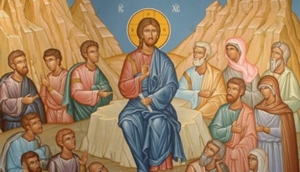
At that time: Seeing the crowds, Jesus went up on the mountain, and when he sat down, his disciples came to him. And he opened his mouth and taught them, saying:
‘Blessed are the poor in spirit, for theirs is the kingdom of heaven.
Blessed are those who mourn, for they shall be comforted.
Blessed are the meek, for they shall inherit the earth.
Blessed are those who hunger and thirst for righteousness, for they shall be satisfied.
Blessed are the merciful, for they shall receive mercy.
Blessed are the pure in heart, for they shall see God.
Blessed are the peacemakers, for they shall be called sons of God. Blessed are those who are persecuted for righteousness’ sake, for theirs is the kingdom of heaven.
Blessed are you when others revile you and persecute you and utter all kinds of evil against you falsely on my account. Rejoice and be glad, for your reward is great in heaven.’
Contemplation
On this 4th Sunday in Ordinary time A let us go up the mountain with Jesus and the crowd and listen to him telling us what is required to deepen our relationship with God.
-
Who are you in the passage? One of the disciples? One of the crowd? A bystander? Yourself?
-
What time of day is it?
-
Take some time to take in the surroundings. Visualise the mountain. Is it a grassy slope or a rocky outcrop? Is there much vegetation; trees, plants, bushes?
-
Look at the people around you. Look at the expressions on their faces. What do you notice? Do you know anyone? Did you come alone?
-
Where are you in the crowd? In the front? Middle? On the margins?
-
Listen to the sounds, the birds, the voices of the crowd, perhaps chatting to each other, the breeze rustling the leaves.
-
Feel the warmth of the sun and the air on your face. Feel the texture of the ground where you are standing or sitting.
-
What smells, and other details about the location do you notice? Perhaps the smell of the air, the colour of the sky, the presence of clouds etc.
-
Notice Jesus as he sits down, a traditional pose for a teacher. Does it surprise you seeing Jesus take a position of authority in order to make his address? Notice the crowd as it falls silent when Jesus starts to speak. Notice the clarity in his voice. What does his voice sound like as he starts to speak?
-
As you listen intently to Jesus, do you:
-
Feel what it’s like to be truly “poor in spirit,” and be completely dependent on God?
-
Feel the sorrow for injustice and sin?
-
Feel gentle, humble, and respectful towards others, understanding you will “inherit the earth”?
-
Feel a deep, hunger for righteousness and justice in the world?
-
Feel God’s mercy flowing through you to others and then back to you?
-
Experience a pure heart that longs to see God?
-
Feel the call to reconcile and bring people together?
-
-
What touches you as he speaks? Which beatitude catches your attention? Perhaps “Blessed are the peacemakers” or “Blessed are the pure in heart”.
-
Which beatitude do you find most challenging? Perhaps “Blessed are you when others revile you and persecute you”.
-
What does the word “Blessed” mean for you? Is there one particular blessing you would like to have? Is there one you would like to have for your family, friends, community?
-
Notice the contradictions in Jesus discourse e.g. he calls the mourning “blessed” and the persecuted “glad”. How does that make you feel?
-
What desires and hopes stir in you as you listen to Jesus’ words?
Let us now spend 10 minutes in the company of Jesus and talk to him about what is going on in your mind and heart regarding his teaching and what challenges you the most. Ask him to give you his Spirit of poverty, meekness, compassion, justice and peace. Speak to him about the blessings you have today and offer thanks for them.
Sharing
Let us now share what we thought, felt etc. only if you are comfortable to do so.
End Prayer
Suscipe of St. Ignatius of Loyola
Take, Lord, and receive all my liberty,
my memory, my understanding,
and my entire will,
All I have and call my own.
You have given all to me.
To you, Lord, I return it.
Everything is yours; do with it what you will.
Give me only your love and your grace,
that is enough for me.
Scripture texts: from the Jerusalem Bible 1966 by Dartington Longman & Todd Ltd and Doubleday and Company Ltd