

By Monika Manser
Introduction
The most frequent way of praying that Saint Ignatius uses is that of imagining ourselves in a Gospel scene. We imagine ourselves as a character in the story. We take part in the story, seeing Jesus and all the other people, being aware of what’s going on and how we are feeling. The purpose of praying with the imagination is to allow Christ in the Scripture to speak to us. To bring the Gospel stories to life for us. We are not trying to recreate history. It doesn’t matter if your imagination takes the story off in a different direction to the Scripture. It doesn’t matter if the story takes place in 1st century Palestine or where we live now in the 21st century. What is important is what God wants to say to us through this passage.
Let us sit and relax so that together we can contemplate the Gospel using our imagination.
Prayer
We acknowledge we are in the presence of God so let us say together:
Direct O Lord and guide and influence all that is happening in my mind and heart during this time of prayer: all my moods and feelings, my memories and imaginings; my hopes and desires; may all be directed and influenced to your greater glory, praise and service and to my growth in your Spirit.
Amen
Let the Spirit enter our hearts and enlighten our minds so that we may discern which are the voices that speak the truth to us.
Reading
Matthew 4:1-11.
At that time: Jesus was led up by the Spirit into the wilderness to be tempted by the devil. And after fasting forty days and forty nights, he was hungry.
And the tempter came and said to him, ‘If you are the Son of God, command these stones to become loaves of bread.’ But he answered, ‘It is written, “Man shall not live by bread alone, but by every word that comes from the mouth of God.”’
Then the devil took him to the holy city and set him on the pinnacle of the Temple and said to him, ‘If you are the Son of God, throw yourself down, for it is written, “He will command his angels concerning you”, and “On their hands they will bear you up, lest you strike your foot against a stone.” ’ Jesus said to him, ‘Again it is written, “You shall not put the Lord your God to the test.”’
Again, the devil took him to a very high mountain and showed him all the kingdoms of the world and their glory. And he said to him, ‘All these I will give you, if you will fall down and worship me.’ Then Jesus said to him, ‘Be gone, Satan! For it is written, “You shall worship the Lord your God and him only shall you serve.”’ Then the devil left him, and behold, angels came and were ministering to him.
Contemplation
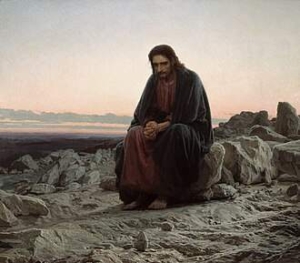
On the First Sunday of Lent, we see Jesus, after his baptism by John, going out to the wilderness to fast and pray for forty days. Imagine the scene and place yourself within this desolate place. With the help of the Spirit, let the story unfold in your imagination and experience Jesus’ hunger and exhaustion after forty days of fasting.
• Who are you within the story? A shepherd? Someone who has followed Jesus into the desert? Perhaps a person or thing that is not specially mentioned in the printed story?
• Visualise the wilderness. Is the landscape flat or mountainous? Are there jagged rocks or shifting sands? Is there any growth of plants or bushes?
• Feel the heat of the sun on your skin by day or the sharp drop in temperature as night falls.
• What sounds do you hear? Perhaps the sound of the breeze or of animals nearby or in the distance? What other details about the location do you notice?
• Where are you? Are you watching from behind a rock? Are you a companion to Jesus? Do you know Jesus?
• Do you notice Jesus being approached? What does the person look like? Is he menacing, or surprisingly ordinary? Can you hear what is being said? Look at the expressions on Jesus’ and the person’s face and listen to the tone of their voices. What happens as you watch and listen?
• Visualise Jesus having already spent forty days fasting in the desert. How does he look – tired, hungry? Hear the tempter say to Jesus, “If you are the Son of God, tell these stones to turn into loaves”. Listen to Jesus respond, “Man does not live on bread alone”. Watch his expression as He chooses trust in God over his personal needs? How does that make you feel?
• Now imagine yourself with Jesus on the highest point of the Temple in Jerusalem; Listen to the temptation to force God’s hand and hear Jesus being challenged to jump and rely on angels. Listen to Jesus’ refusal by quoting Scripture saying “You must not put the Lord your God to the test”. How do you feel? Have you ever put God to the test by wanting divine intervention for something unreasonable?
• Now imagine you are with Jesus standing on top of a high mountain, viewing the splendour and power of all earthly kingdoms. Listen to the tempter as he offers Jesus all of the kingdoms of the world if if he worships him, Jesus this time banishes him by saying “Be off, Satan! For scripture says: “You must worship the Lord your God, and serve him alone.” Had you realised that this was Satan? How do you feel? Are you afraid? Surprised that Satan looked so ordinary? How would you have reacted to this temptation?
• What is your reaction to the temptations of Jesus? How does Jesus’ physical, exhausted, yet focused appearance make you feel? What does it feel like to stand with Jesus as he resists? Do you know yourself and your temptations? Do you put your trust in the protection of God so that you can resist them? Do you ask God daily to “Lead you not into temptation?
As you start your journey through Lent this year, talk to Jesus about the “wilderness” moments in your own life—the areas where you feel tempted to take shortcuts or seek power. Ask Jesus to help you follow him with the same confidence and trust that he had in the face of temptation. Listen to what he says to you about your own struggles?
Sharing
Let us now share what we thought, felt etc. only if you are comfortable to do so.
End Prayer
Suscipe of St. Ignatius of Loyola
Take, Lord, and receive all my liberty,
my memory, my understanding,
and my entire will,
All I have and call my own.
You have given all to me.
To you, Lord, I return it.
Everything is yours; do with it what you will.
Give me only your love and your grace,
that is enough for me.
Scripture texts: from the Jerusalem Bible 1966 by Dartington Longman & Todd Ltd and Doubleday and Company Ltd