

By Monika Manser
Introduction
The most frequent way of praying that Saint Ignatius uses is that of imagining ourselves in a Gospel scene. We imagine ourselves as a character in the story. We take part in the story, seeing Jesus and all the other people, being aware of what’s going on and how we are feeling. The purpose of praying with the imagination is to allow Christ in the Scripture to speak to us. To bring the Gospel stories to life for us. We are not trying to recreate history. It doesn’t matter if your imagination takes the story off in a different direction to the Scripture. It doesn’t matter if the story takes place in 1st century Palestine or where we live now in the 21st century. What is important is what God wants to say to us through this passage.
Let us sit and relax so that together we can contemplate the Gospel using our imagination.
Prayer
We acknowledge we are in the presence of God so let us say together:
Direct O Lord and guide and influence all that is happening in my mind and heart during this time of prayer: all my moods and feelings, my memories and imaginings; my hopes and desires; may all be directed and influenced to your greater glory, praise and service and to my growth in your Spirit.
Amen
Let the Spirit enter our hearts and enlighten our minds so that we by our Baptism can make Jesus Christ known to the world through what we say and what we do
Reading
John 1:29-34
At that time: John saw Jesus coming towards him, and said, ‘Behold, the Lamb of God, who takes away the sin of the world! This is he of whom I said, “After me comes a man who ranks before me, because he was before me.” I myself did not know him, but for this purpose I came baptising with water, that he might be revealed to Israel.’
And John bore witness: ‘I saw the Spirit descend from heaven like a dove, and it remained on him. I myself did not know him, but he who sent me to baptise with water said to me, “He on whom you see the Spirit descend and remain, this is he who baptises with the Holy Spirit.” And I have seen and have borne witness that this is the Son of God.’
Contemplation
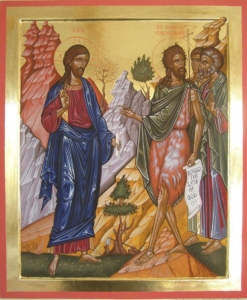
Although we will be hearing from St Matthew’s Gospel in this Liturgical year, (Cycle A), today’s reading is taken from St John’s Gospel. Last week we heard St Matthew’s account of the Baptism of Jesus. In John’s account, we hear John the Baptist announcing that he knows that Jesus is the Son of God by witnessing the Spirit coming down on him. Let us enter the scene in the company of John the Baptist.
• Who are you in the passage? John the Baptist? One of John’s disciples? One to whom John was speaking? Perhaps someone or something not mentioned in the passage?
• Take some time to take in the surroundings, the countryside, the birds, the sunshine or clouds, the heat of the day, the terrain, the vegetation. Feel the soil on your feet. Feel the air around you.
• What sounds, smells, and other details about the location do you notice?
• Imagine yourself present with John the Baptist near the Jordan River. Are there many people there listening to him? Look at the faces of the people around you and notice them. Is there anyone you recognise? Listen to what John says to you and those present, both about himself and about the one coming after him. Listen to the whispers of the crowd. How does it make you feel?
• You notice that John’s cousin Jesus, whom you may have witnessed being baptised by John, is coming toward you. Do you recognise him as the son of Joseph the Carpenter and of Mary? Notice everything you can about him – what he’s wearing, how tall he is, the expression on his face. What does he look like as he approaches you? Do you catch his eye?
• As you hear John say, “Behold, the Lamb of God who takes away the sin of the world.” What does his voice sound like? Is it full of awe? Excitement? Recognition? What do you see in Jesus? What thoughts and feelings arise in you about what the Lamb of God means? Maybe you recall the verses in Isaiah about the one who was led like a lamb to the slaughter or the one who was an innocent victim who would endure his sufferings to redeem his people. Do you wonder if this will be the destiny of Jesus?
• What arises in you at the words “who takes away the sin of the world”? Reflect on the sin of the world and what it means for you? Do John’s words fill you with hope and purpose?
• Listen to John bearing witness to Jesus’ Baptism and seeing the Spirit descend upon Jesus. How does his voice sound now? Perhaps you too witnessed the Spirit shaped like a dove descend on Jesus. Does John’s witness help you recognise the identity of Jesus as the Son of God? Does his witness encourage you too to bear witness?
• As you look at Jesus again, how do you now see him?
• How has the encounter with John and Jesus affected you? What about the people who are also present? Do they too look as though they have been affected in some way?
As we spend 10 minutes in quiet contemplation, speak to Jesus and tell Him what this experience means for your life, your own baptism, and your mission to bring others to Him.
Sharing
Let us now share what we thought, felt etc. only if you are comfortable to do so.
End Prayer
Suscipe of St. Ignatius of Loyola
Take, Lord, and receive all my liberty,
my memory, my understanding,
and my entire will,
All I have and call my own.
You have given all to me.
To you, Lord, I return it.
Everything is yours; do with it what you will.
Give me only your love and your grace,
that is enough for me.
Scripture texts: from the Jerusalem Bible 1966 by Dartington Longman & Todd Ltd and Doubleday and Company Ltd