

By Monika Manser
Introduction
The most frequent way of praying that Saint Ignatius uses is that of imagining ourselves in a Gospel scene. We imagine ourselves as a character in the story. We take part in the story, seeing Jesus and all the other people, being aware of what’s going on and how we are feeling. The purpose of praying with the imagination is to allow Christ in the Scripture to speak to us. To bring the Gospel stories to life for us. We are not trying to recreate history. It doesn’t matter if your imagination takes the story off in a different direction to the Scripture. It doesn’t matter if the story takes place in 1st century Palestine or where we live now in the 21st century. What is important is what God wants to say to us through this passage.
Let us sit and relax so that together we can contemplate the Gospel using our imagination.
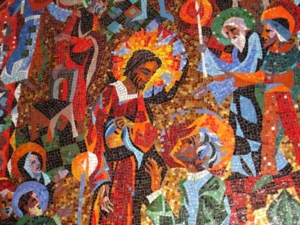
Prayer
We acknowledge we are in the presence of God so let us say together:
Direct O Lord and guide and influence all that is happening in my mind and heart during this time of prayer: all my moods and feelings, my memories and imaginings; my hopes and desires; may all be directed and influenced to your greater glory, praise and service and to my growth in your Spirit.
Amen
Let the Spirit guide our hears and enlighten our minds as we read the Gospel and reflect on what it means to have Jesus appear in our midst. Let the Spirit enter you so that you too can see and hear the risen Lord.
Reading
John 20:19 – 31
On the evening of that day, the first day of the week, the doors being locked where the disciples were for fear of the Jews, Jesus came and stood among them and said to them, ‘Peace be with you.’ When he had said this, he showed them his hands and his side. Then the disciples were glad when they saw the Lord. Jesus said to them again, ‘Peace be with you. As the Father has sent me, even so I am sending you.’ And when he had said this, he breathed on them and said to them, ‘Receive the Holy Spirit. If you forgive the sins of any, they are forgiven them; if you withhold forgiveness from any, it is withheld.’
Now Thomas, one of the Twelve, called the Twin, was not with them when Jesus came. So the other disciples told him, ‘We have seen the Lord’. But he said to them, ‘Unless I see in his hands the mark of the nails, and place my finger into the mark of the nails, and place my hand into his side, I will never believe.’
Eight days later, his disciples were inside again, and Thomas was with them. Although the doors were locked, Jesus came and stood among them and said, ‘Peace be with you.’ Then he said to Thomas, ‘Put your finger here, and see my hands; and put out your hand, and place it in my side. Do not disbelieve, but believe.’ Thomas answered him, ‘My Lord and my God!’ Jesus said to him, ‘Have you believed because you have seen me? Blessed are those who have not seen and yet have believed.’
Now Jesus did many other signs in the presence of the disciples, which are not written in this book; but these are written so that you may believe that Jesus is the Christ, the Son of God, and that by believing you may have life in his name.
Contemplation
In today’s Gospel, we see the risen Christ appearing to his disciples in physical form through a locked door. Imagine the scene, find a place within it. With the help of the Spirit, let the story unfold in your imagination.
- Who are you within the story? Are you, one of the disciples; the absent Thomas? Perhaps a person that is not specially mentioned in the printed story?
- Imagine you are in the locked room with the disciples. Imagine the atmosphere—is it dim, stuffy, crowded, filled with fear? What time of day is it? Look around the room. Is it dark or is there a sliver of evening light?.
- You are sitting among the disciples. Who else is in the room with you? Feel the tension after the recent execution. How do you feel? Full of grief, tension, confusion, fear? What are you afraid of? Are you whispering in fear?
- Jesus suddenly stands among you despite the locked doors and says, “Peace be with you” and shows you his hands and side. Focus on his face and his scars. What emotions arise in you—awe, fear, joy? Do you feel your fear and guilt ebb away?
- How did you feel when Jesus breathed on you offering the Holy Spirit? Breathed on your chaos and fear? Did it fill you with peace? Did it bring you new life?
- Experience this quiet, intimate moment as he commissions the disciples—and you—to continue his work. How do you feel when he entrusts you with a mission? Do you feel you can accomplish this? Do you feel new life or courage stirring within you?.
- What do you tell Thomas when he returns? How does he take the news? How do you react to his retort that unless he can put his fingers into the holes the nails made and his hand into his pierced side, he will not believe? Can you identify with Thomas, wanting hard evidence before you believe? Do you feel his doubt and confusion? What proof do you need to believe?
- Imagine yourself present a week later. Watch Jesus engage with Thomas’s doubt. Hear him say, “Blessed are those who have not seen and yet have believed.” How does that challenge or comfort you?.Watch as Jesus invites Thomas to touch His wounds. If you were Thomas, what would it feel like to hear Jesus say, “Doubt no longer but believe”?.
- How do you feel when Jesus says to you ‘You believe because you can see me. Happy are those who have not seen and yet believe.’?
Speak to Jesus about how you feel and the words of encouragement you would like to hear from him? Ask him for the grace to believe without seeing and to be open to experiences where God’s unmistakable presence can be recognised. Share your fears or doubts just as Thomas did, and listen to what he says to you.
We will sit with our thoughts and imagination for 10 minutes
Sharing
Let us now share what we thought, felt etc. only if you are comfortable to do so.
End Prayer
Suscipe of St. Ignatius of Loyola
Take, Lord, and receive all my liberty,
my memory, my understanding,
and my entire will,
All I have and call my own.
You have given all to me.
To you, Lord, I return it.
Everything is yours; do with it what you will.
Give me only your love and your grace,
that is enough for me.
Scripture texts: from the Jerusalem Bible 1966 by Dartington Longman & Todd Ltd and Doubleday and Company Ltd