

By Monika Manser
Introduction
The most frequent way of praying that Saint Ignatius uses is that of imagining ourselves in a Gospel scene. We imagine ourselves as a character in the story. We take part in the story, seeing Jesus and all the other people, being aware of what’s going on and how we are feeling. The purpose of praying with the imagination is to allow Christ in the Scripture to speak to us. To bring the Gospel stories to life for us. We are not trying to recreate history. It doesn’t matter if your imagination takes the story off in a different direction to the Scripture. It doesn’t matter if the story takes place in 1st century Palestine or where we live now in the 21st century. What is important is what God wants to say to us through this passage.
Let us sit and relax so that together we can contemplate the Gospel using our imagination.
Prayer
We acknowledge we are in the presence of God so let us say together:
Direct O Lord and guide and influence all that is happening in my mind and heart during this time of prayer: all my moods and feelings, my memories and imaginings; my hopes and desires; may all be directed and influenced to your greater glory, praise and service and to my growth in your Spirit.
Amen
Let the Spirit enter our hearts and enlighten our minds to that fact that nothing is impossible to God if only we have the faith to believe.
Reading
John 11: 1-45 (Abridged)
At that time: The sisters of Lazarus sent to Jesus, saying, ‘Lord, he whom you love is ill.’ But when Jesus heard it he said, ‘This illness does not lead to death. It is for the glory of God, so that the Son of God may be glorified through it.’
Now Jesus loved Martha and her sister and Lazarus. So, when he heard that Lazarus was ill, he stayed two days longer in the place where he was. Then after this he said to the disciples, ‘Let us go to Judea again.’
Now when Jesus came, he found that Lazarus had already been in the tomb four days. So when Martha heard that Jesus was coming, she went and met him, but Mary remained seated in the house. Martha said to Jesus, ‘Lord, if you had been here, my brother would not have died. But even now I know that whatever you ask from God, God will give you.’ Jesus said to her, ‘Your brother will rise again.’ Martha said to him, ‘I know that he will rise again in the resurrection on the last day.’ Jesus said to her, ‘I am the resurrection and the life. Whoever believes in me, though he die, yet shall he live, and everyone who lives and believes in me shall never die. Do you believe this?’ She said to him, ‘Yes, Lord; I believe that you are the Christ, the Son of God, who is coming into the world.’
Jesus was deeply moved in his spirit and greatly troubled. And he said, ‘Where have you laid him?’ They said to him, “Lord, come and see.” Jesus wept. So the Jews said, ‘See how he loved him!’ But some of them said, ‘Could not he who opened the eyes of the blind man also have kept this man from dying?’
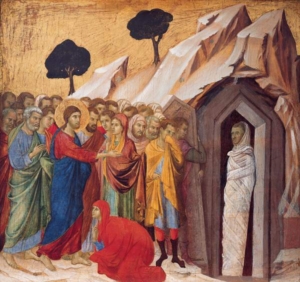
Then Jesus, deeply moved again, came to the tomb. It was a cave, and a stone lay against it. Jesus said, ‘Take away the stone.’ Martha, the sister of the dead man, said to him, ‘Lord, by this time there will be a smell, for he has been dead four days.’ Jesus said to her, ‘Did I not tell you that if you believed you would see the glory of God?’ So they took away the stone. And Jesus lifted up his eyes and said, ‘Father, I thank you that you have heard me. I knew that you always hear me, but I said this on account of the people standing around, that they may believe that you sent me.’ When he had said these things, he cried out with a loud voice, ‘Lazarus, come out.’ The man who had died came out, his hands and feet bound with linen strips, and his face wrapped with a cloth. Jesus said to them, ‘Unbind him, and let him go.’
Many of the Jews therefore, who had come with Mary and had seen what he did, believed in him.
Contemplation
Today’s Gospel on the 5th Sunday of Lent and tells of the Raising of Lazarus found in John’s Gospel. This scene at Bethany is a sad one, not only for Martha and Mary who have just lost their brother but for Jesus who has lost a friend. Imagine the scene, find a place within it. With the help of the Spirit, let the story unfold in your imagination.
• Who are you within the story? Are you Martha, busy and anxious? Mary, overcome with grief? Lazarus bewildered as he emerges from the tomb? One of the disciples, fearful of returning to Judea? A grieving friend or an unnoticed bystander? Perhaps a person or thing that is not specially mentioned in the printed story?
• See the dusty road to Bethany. Imagine a small, dusty house filled with weeping friends and mourners. Look at the faces of the mourners. Picture the sisters, tired and desperate, sending for Jesus, then waiting, their hope fading. Is there an atmosphere of grief, confusion or even anger?
• Imagine Jesus when he received the message from the sisters. Now picture Him staying two extra days, his quiet confidence contrasted with the disciples’ fear of returning to Judea. Do you think that Jesus should have gone to Martha and Mary immediately he received the message? Why do you think he delayed?
• Reflect on how it feels to wait for Jesus when you are in desperate need. Do you think that Martha and Mary felt confused or abandoned by His two-day delay? Have you ever felt abandoned by God when you have asked for help?
• Watch the reactions of Martha and Mary when they see the arrival of Jesus. See Martha’s meeting with Jesus on the road, expressing both faith and disappointment. How do you feel about the accusatory remarks by Martha when she sees Jesus? Do you agree with her? How do you feel about her profound faith on one hand and disappointment, even anger that he hadn’t come sooner on the other hand?
• Imagine Mary running to Jesus, falling at his feet, weeping the same words of sorrow.
• Do you notice Jesus reacting differently to the two sister?. To Martha’s questions, Jesus questions her faith? To Mary’s anguish, Jesus shares her distress? Do you hear his sigh coming straight from his heart?
• Notice Jesus weeping for his friend, showing his humanity, while simultaneously demonstrating divine power over death.
• Walk with Jesus to the tomb—a dark, cold cave sealed with a heavy stone. Feel the tension as he orders it moved. Hear his loud voice: “Lazarus, come out!”.What do you hear, see or feel when you see Jesus calling Lazarus from the tomb? Are you afraid when you see Lazarus being brought back from the dead? What are the reactions of those around you? Do you help to unbind Lazarus?
• From what do you wish to ask Jesus to help me unbind? From where do need him to free you, so that you can experience more fully the life he wants you to lead?
Speak to Jesus about the times you have been entombed in hopelessness and bound by worry. Tell him about the areas in your life that feel dead. Ask him for the grace to hear his voice call, “Unbind him. Let him go”
We will sit with our thoughts and imagination for 10 minutes
Sharing
Let us now share what we thought, felt etc. only if you are comfortable to do so.
End Prayer
Suscipe of St. Ignatius of Loyola
Take, Lord, and receive all my liberty,
my memory, my understanding,
and my entire will,
All I have and call my own.
You have given all to me.
To you, Lord, I return it.
Everything is yours; do with it what you will.
Give me only your love and your grace,
that is enough for me.
Scripture texts: from the Jerusalem Bible 1966 by Dartington Longman & Todd Ltd and Doubleday and Company Ltd