

By Monika Manser
Introduction
The most frequent way of praying that Saint Ignatius uses is that of imagining ourselves in a Gospel scene. We imagine ourselves as a character in the story. We take part in the story, seeing Jesus and all the other people, being aware of what’s going on and how we are feeling. The purpose of praying with the imagination is to allow Christ in the Scripture to speak to us. To bring the Gospel stories to life for us. We are not trying to recreate history. It doesn’t matter if your imagination takes the story off in a different direction to the Scripture. It doesn’t matter if the story takes place in 1st century Palestine or where we live now in the 21st century. What is important is what God wants to say to us through this passage.
Sit and relax by focussing on your breathing for a few minutes so that you can contemplate the Gospel using your imagination.
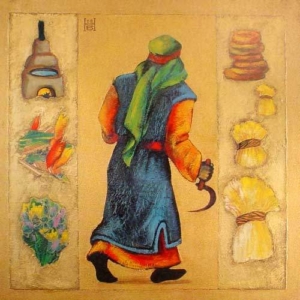
Prayer
Acknowledge you are in the presence of God by saying the following prayer:
Direct O Lord and guide and influence all that is happening in my mind and heart during this time of prayer: all my moods and feelings, my memories and imaginings; my hopes and desires; may all be directed and influenced to your greater glory, praise and service and to my growth in your Spirit.
Amen
Let the Spirit enter our hearts and enlighten our minds as we listen to and reflect on Jesus explaining the Kingdom of heaven. Let the Spirit enrich our hearts and minds so that we can identify the wheat and weeds in our lives; that we can identify what is life giving and what is life taking.
Reading
Matthew 13:24-30 (Short Version)
At that time: Jesus put another parable before the crowd, saying, ‘The kingdom of heaven may be compared to a man who sowed good seed in his field, but while his men were sleeping, his enemy came and sowed weeds among the wheat and went away. So when the plants came up and bore grain, then the weeds appeared also. And the servants of the master of the house came and said to him, “Master, did you not sow good seed in your field? How then does it have weeds?” He said to them, “An enemy has done this.” So the servants said to him, “Then do you want us to go and gather them?” But he said, “No, lest in gathering the weeds you root up the wheat along with them. Let both grow together until the harvest, and at harvest time I will tell the reapers, ‘Gather the weeds first and bind them in bundles to be burned, but gather the wheat into my barn.’
Contemplation
This passage from St Matthew’s Gospel, the sixteenth Sunday in Ordinary Time, follows on from last week’s Gospel reading in which Jesus is describing the Kingdom of heaven in parables, using every day imagery to capture the minds of his listeners. So close your eyes, imagine the scene and find a place within it.
-
Who are you in the scene? Someone who is listening e.g. a disciple, a passer-by, one of the crowd?
-
Perhaps you are the person who sowed the seed, or the servant who wanted to pull up the weed, or the master who is trusting enough to let the wheat and the weeds grow together; or even the wheat or the weed themselves striving to grow?
-
Imagine you are looking out over the field. Notice that in some patches, the wheat stands tall and golden. In others, a weed intertwines with the crop, looking almost identical in its early stages.
-
Listen to the rustle of the stalks in a gentle breeze, the distant sound of birds, and the murmur of the workers.
-
Feel the rough soil beneath your feet and the warmth of the afternoon sun on your back.
-
Imagine you are looking at the sower. Can you feel his steady, patient gaze taking in the crop? Can you imagine his disappointment that his crop is being ruined by an enemy? The good crop he planted the previous season?
-
Imagine you are looking at the servant who discovered the weeds and feeling his sense of confusion, frustration, and a desire to immediately fix the problem.
- Does it surprise you that farmer wants the wheat and the weeds to grow side by side? That his primary focus is protecting the wheat?
- Imagine the field being your heart or community, or the world. What are the good things (wheat) growing? What are the destructive influences or anxieties (weeds)?
- Imagine what it means to be a mixture of good seeds and weeds. How can you learn to be patient and tolerant with your weaknesses so that the good wheat, your strengths can flourish? How often do you get impatient when you are you striving to grow and you get tangled up in distractions?
- Like the servants, how often do you want to weed out imperfections in yourself or others before the time is right? Does it trouble you that the wheat and the weeds (good and bad) can co-exist? What does it feel like to know that God practices immense patience, choosing to protect your growth rather than risk destroying you in the pursuit of immediate perfection?
Talk to God about the weeds causing you anxiety at this moment in time, and surrender them to His ultimate care, trusting in His perfect timing to make things right. Ask Jesus to help you make the right choices in life so that you can give rise to the wheat within you.
Sharing
Let us now share what we thought, felt etc. only if you are comfortable to do so.
End Prayer
Suscipe of St. Ignatius of Loyola
Take, Lord, and receive all my liberty,
my memory, my understanding,
and my entire will,
All I have and call my own.
You have given all to me.
To you, Lord, I return it.
Everything is yours; do with it what you will.
Give me only your love and your grace,
that is enough for me.
Scripture texts: from the Jerusalem Bible 1966 by Dartington Longman & Todd Ltd and Doubleday and Company Ltd
